Your sustainability claims need proof.Ask Ali is the only fully compliant Shariah AI co-pilot — powered by ZeroH Disclosure.
Islamic finance and ESG share the same demand: verifiable compliance. Ali maps your Shariah governance to sustainability frameworks, creating evidence trails that satisfy both regulatory and ethical mandates.
Sign in with your work email or Google to try Ask Ali and experience ZeroH Disclosure.
By using Ask Ali you agree to the Research Preview Terms & Conditions.
Islamic digital banks do not need another AI chatbot. They need a system that turns legal and Shariah requirements into day-to-day operating controls, lets teams use AI responsibly, and gives management, Shariah boards, auditors, and regulators something they can verify. Our technology starts before the cloud. Data does not leave the institution’s control unless the relevant disclosure policy has been applied first, so that institutions can actually use the cloud.
Sami Mian
Chief Executive Officer, Blade Labs
Islamic banks want to use AI.The rules say no, unless you are compliant, and can prove it.
Data sovereignty laws, privacy regulations, and Shariah governance all demand the same thing: evidence the policy was applied. Most AI deployments enforce this inside the cloud, after the data has already left.
Sensitive data leaves before policy is applied
Generic AI sends raw text to the model first, then tries to manage it after. By then the data has already crossed the institutional boundary.
Generic models hallucinate citations
A confident but wrong AAOIFI reference is worse than no answer. Compliance teams cannot ship structures based on fabricated standards.
Scholar capacity does not scale
The top 20 Shariah scholars hold 621 board seats. Reviews queue up, products slip, and rework after late-stage rejection costs more than early screening.
Audit evidence assembled at the last minute
When a regulator examines you, the question is always the same: prove your policy was applied. Reconstructing that record after the fact is what most platforms force you to do.
Inside ZeroH Disclosure
Your data stays under your policy.The model only sees what you allow.
ZeroH Disclosure applies your institution’s policy at the prompt boundary. By the time anything reaches an external AI service, sensitive fields have already been redacted and the disclosure has been audit-trailed inside your sovereign region.
Your device
Browser · macOS
- PII detection
- Masking
Original prompt never leaves your device
Qatar
Sovereign region
- Audit trail
- Encrypted in-region storage
Designed to stamp a verifiable record, in region
Anthropic (US)
Claude
- Masked prompt only
- Returns answer
Sees only redacted tokens
Built for how Shariah governance actually works.
Every answer cites the standard. Every analysis covers the four schools. Every decision maps to the higher objectives. Every disclosure produces a record.
Source attribution
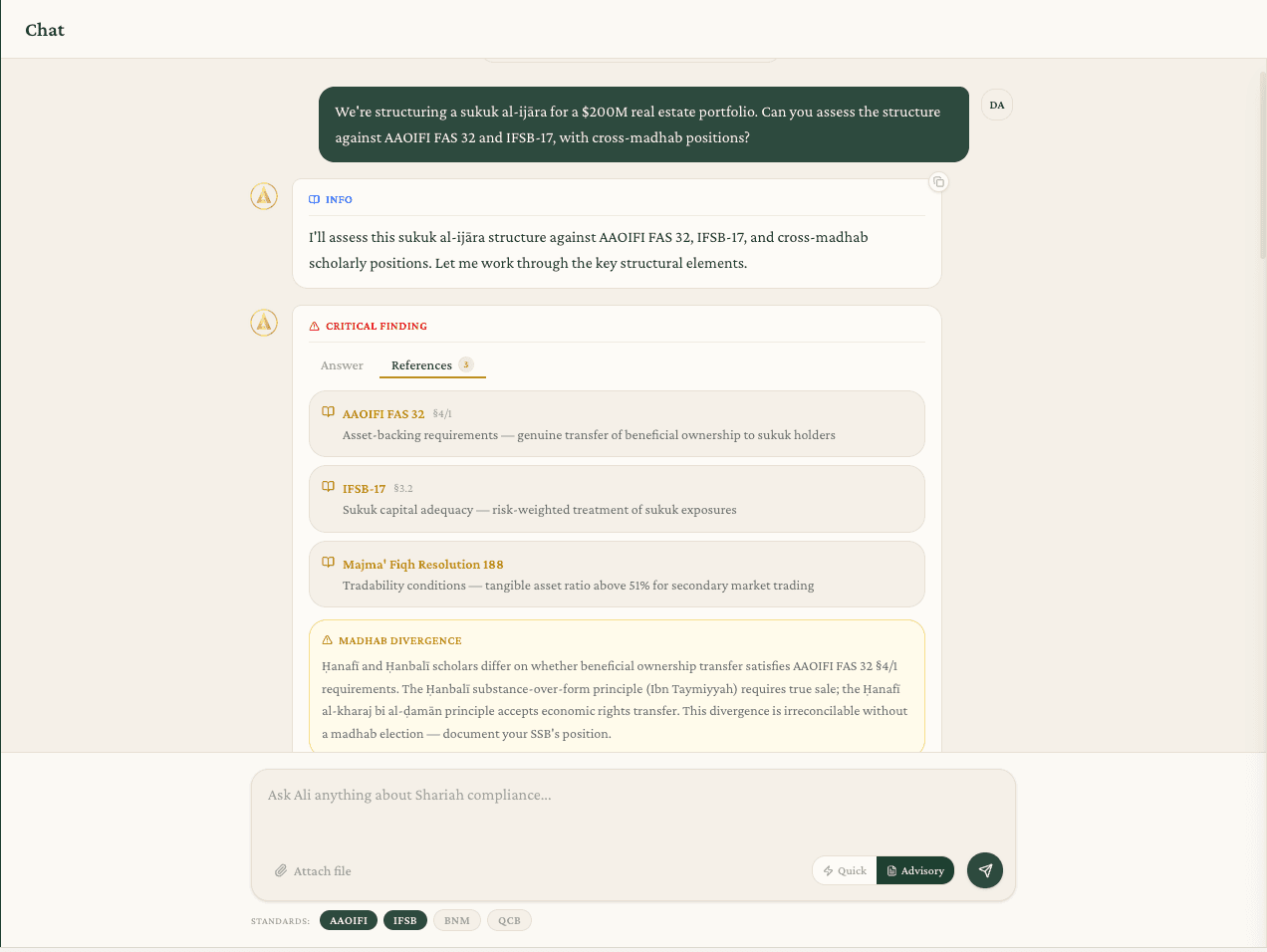
Every answer cites its source.
Ali names the AAOIFI standard, clause, and version, plus IFSB and BNM equivalents where relevant. If the source is not in the corpus, Ali says so. No fabricated references.
Multi-madhahib analysis
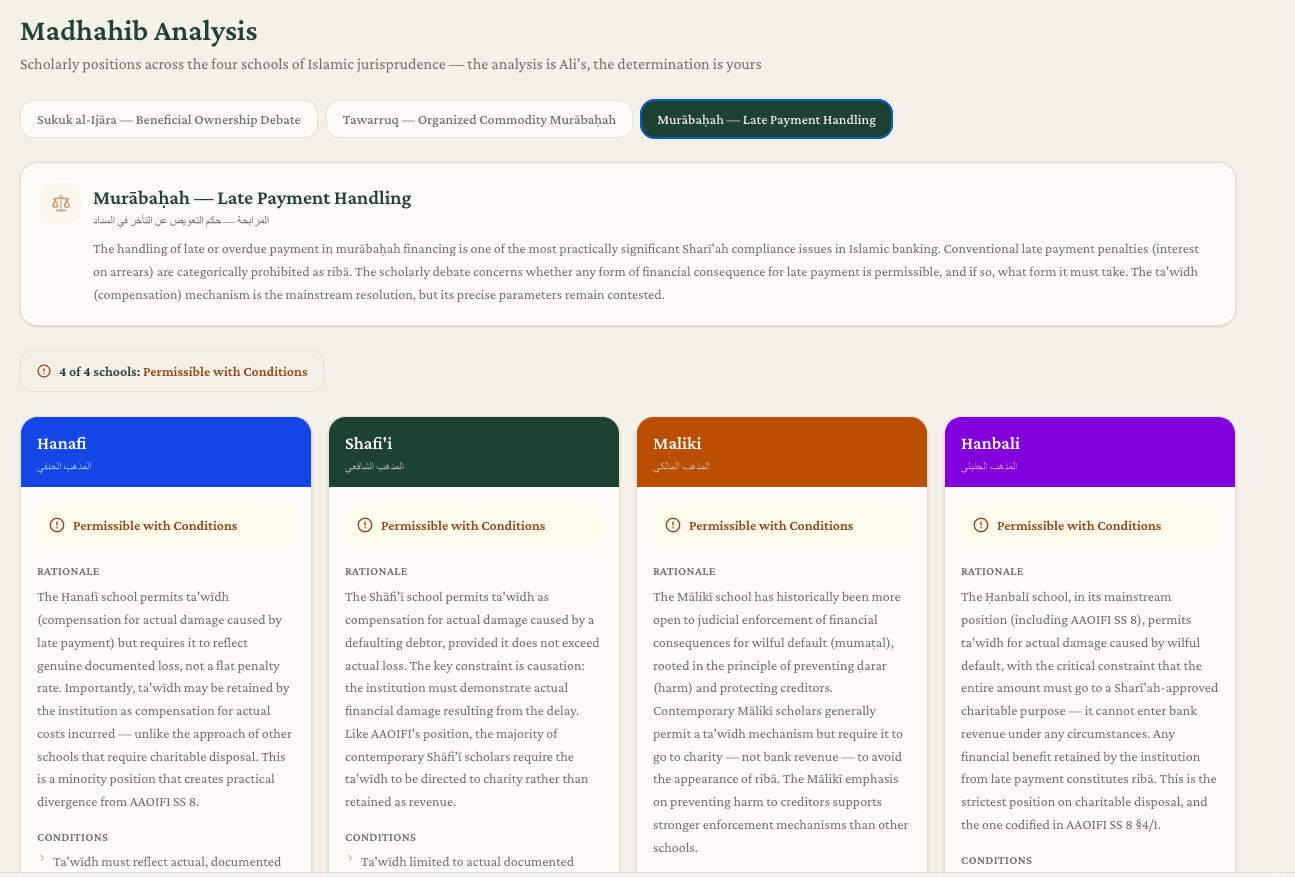
Four schools of thought, side by side.
Hanafi, Shafiʻi, Maliki, and Hanbali positions presented together with the scholarly source for each. Your Shariah board selects the applicable view. Ali documents the reasoning.
Maqasid al-Shariah
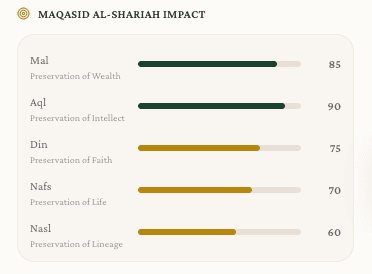
Compliance mapped to purpose.
Every analysis maps findings to the five higher objectives: Faith, Life, Intellect, Lineage, and Wealth. Connects technical compliance to the question regulators are asking.
Ali in action
Murabaha contract review.
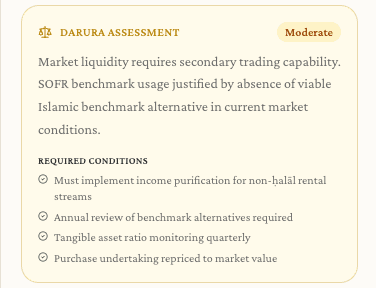
A real example. One contract, three tiers of findings, board-ready output. Ali handles the research; your Shariah board makes the call.
Example: Murabaha contract review
Upload
Upload a 12-page Murabaha contract from your Islamic digital bank pipeline.
Ali identifies
- 2 critical: late payment penalty (riba risk under AAOIFI SS 8)
- 3 moderate: fee justification, commodity specification
- 5 compliant: profit rate disclosure, ownership transfer
Ali delivers
- Clause-level remediations with the standard reference for each
- Multi-madhahib analysis on the contested clauses
- Maqasid mapping for board discussion
- Audit-ready summary with cryptographic record
Time saved
Why Ali is different
A purpose-built compliance tool.
Generic AI tools generate text about Islamic finance. Ali supports compliance decisions with verifiable sources, controlled disclosure, and an audit trail.
Sources
Generic AI: Trained on public web. Confident answers without traceable origin.
Ali · Powered by ZeroH Disclosure: Cites the AAOIFI/IFSB/BNM standard, clause, and version. If source not found, says so.
Madhahib coverage
Generic AI: Surfaces one position, often majority view, no scholarly source.
Ali · Powered by ZeroH Disclosure: Presents Hanafi, Shafiʻi, Maliki, and Hanbali side by side, each with sources.
Data handling
Generic AI: Raw prompt sent to the model. Policy enforced after the fact.
Ali · Powered by ZeroH Disclosure: Policy applied at the prompt boundary. Original data does not leave your device.
Audit trail
Generic AI: Best-effort logs scattered across vendors and regions.
Ali · Powered by ZeroH Disclosure: Cryptographic record of every disclosure, stamped in your sovereign region.
Limits
Generic AI: Will answer outside its competence.
Ali · Powered by ZeroH Disclosure: Transparent about boundaries. Defers to your Shariah board on judgment calls.
Trust and security
Enterprise-grade.Proven track record.
Built by a team that has been deploying Islamic finance technology with regulators and Shariah boards. Certified to the standards your security team will ask about.
Security Certifications
SOC 2 Type II
ISO 27001:2022
GDPR
UK Patent Pending
Track Record
FinoPitch International Grand Prize 2025
Tokyo. Sustainable ESG Islamic Finance Platform category.
Islamic Fintech Awards 2025
Dubai. Best Startup.
QDB and Qatar FinTech Hub portfolio company
Registered at the Qatar Financial Centre, active in the QFC Digital Assets Lab.
Fatwa pronouncement from Amanie Advisors
The ZeroH platform methodology that Ali is built on holds a full fatwa pronouncement from Amanie Advisors (April 2025), covering the platform digitalisation services that underpin Ask Ali.
Frequently asked questions
Ali maps Maqasid al-Shariah objectives to ESG framework requirements, identifying where Islamic finance principles and sustainability mandates overlap. This creates a unified compliance view that reduces duplicate reporting and strengthens both narratives.
Yes. Ali maps CSRD reporting requirements against existing Shariah governance documentation, identifying where compliance evidence already exists and where new data collection is needed. Many Islamic finance institutions find they're already partially CSRD-compliant through their Shariah governance work.
Ali applies the same evidence trail methodology used for Shariah compliance to sustainability claims. Every assertion is traceable to its source: the governing framework, the specific requirement, the assessment methodology, and the supporting evidence. This standard of proof satisfies both religious and regulatory auditors.
Yes. The mapping draws from established Islamic finance scholarship on the alignment between Maqasid al-Shariah and sustainable development goals. Ali cites the scholarly sources and framework references that support each mapping.
Ali covers major sustainability frameworks including CSRD, SFDR, TCFD, EU Taxonomy, and GRI, alongside comprehensive Shariah governance standards (AAOIFI, IFSB). Cross-framework mapping identifies overlapping requirements automatically.
Ali generates structured responses to ESG questionnaires using verified evidence from your existing Shariah governance data. For Islamic financial institutions, much of the evidence investors request already exists in your compliance documentation. Ali surfaces and structures it.
Talk to us about Ask Ali
Bridge Shariah governance and sustainability reporting with unified evidence trails. Prove compliance to both your SSB and sustainability committee from one source.
Your email will only be used to follow up about Ask Ali for your institution. No marketing emails.
Public preview opens to anyone on 12 May 2026.
Free 81-Point Compliance Checklist
Covers governance, product, regulatory, audit, and ESG requirements. No signup required.
Download Free ChecklistPowered by Blade Labs' ZeroH Disclosure technology
Contact