See every cow, every dollar, every step.
The Mudarabah app runs a Shariah-compliant cattle-fattening partnership from the first dollar to the last cow sold. The investor puts in the capital, the farm operator does the work, and the app records every purchase, payment and animal as it happens. Both sides confirm each payment, the contract keeps its own deadlines, and every cow is enrolled in takaful against specified risks.
- Capital in the pilot
- $100,000
- from Blade Labs as Rab al-Mal
- Cows in the herd
- 22
- fattening phase
- Obligations tracked
- 41
- each with an owner and a deadline
- Contract signed
- 16 Mar 2026
- 70/30 investor/operator split
Four promises to the investor. Software keeps them.
Livestock is a high-risk investment that is hard to watch from far away. The app answers the four questions an investor asks first.
The investor sees what the farm sees, the same day.
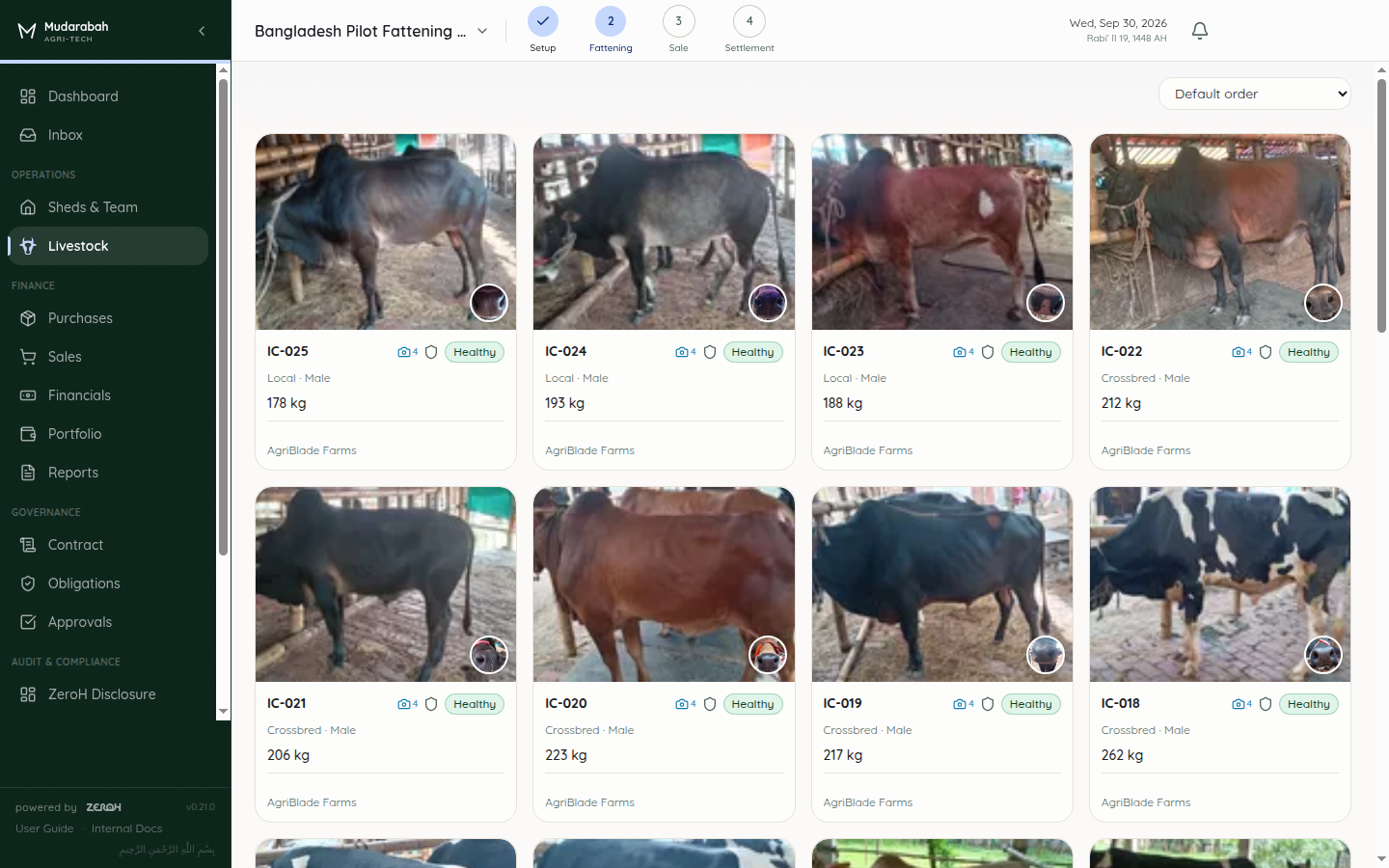
The Rab al-Mal follows the capital as it is deployed, each animal with its photos, muzzle print and weight, every cost and what it paid for, and where the cycle stands.
When the operator records a purchase, it shows up on the investor’s dashboard that day.
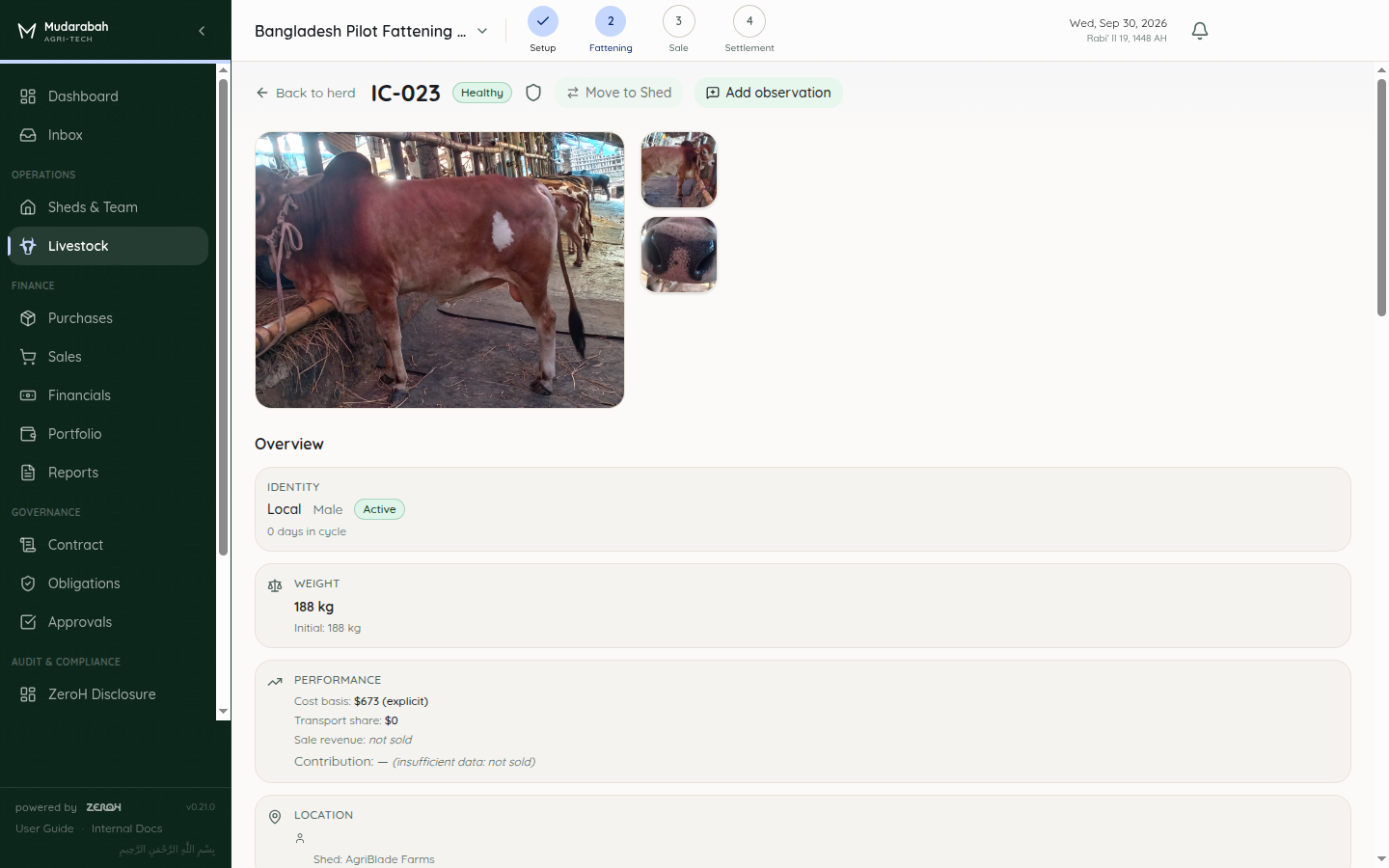
Both sides confirm every payment.
The payer records each payment with its receipt; the payee confirms it from their own login. When the operator pays a vet $150, the vet confirms receiving $150. If the amounts differ, the app opens a dispute.
Every record goes into immutable storage. Nobody can change it afterwards, including us.
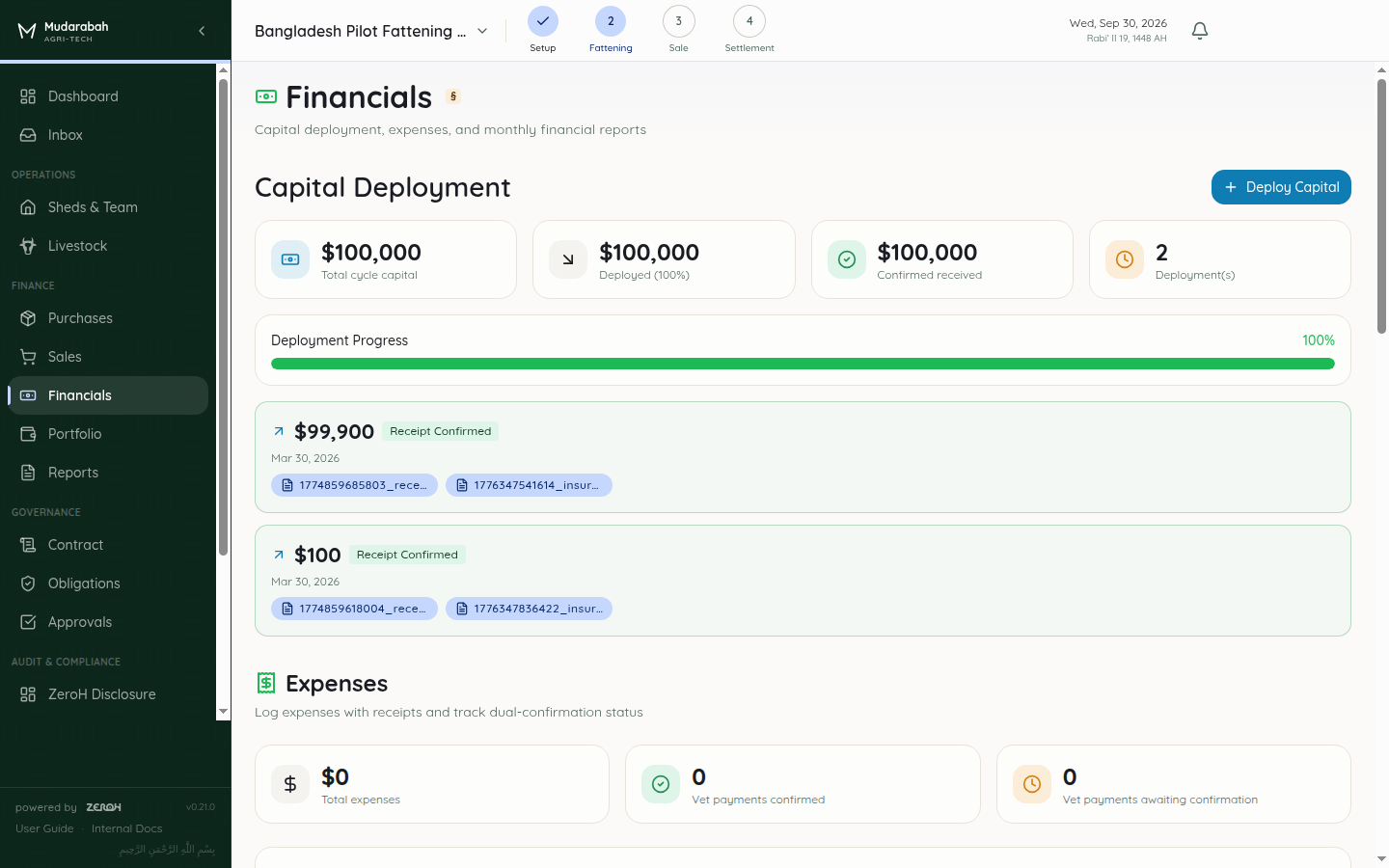
The contract keeps its own deadlines.
Each clause of the signed agreement becomes an obligation with an owner and a deadline: register a new cow within 48 hours, report an incident within 24 hours, file the monthly financial report, hold the quarterly Shariah review.
Everyone sees what comes next and who it waits on, and the app sends the reminders. A missed deadline escalates on its own.
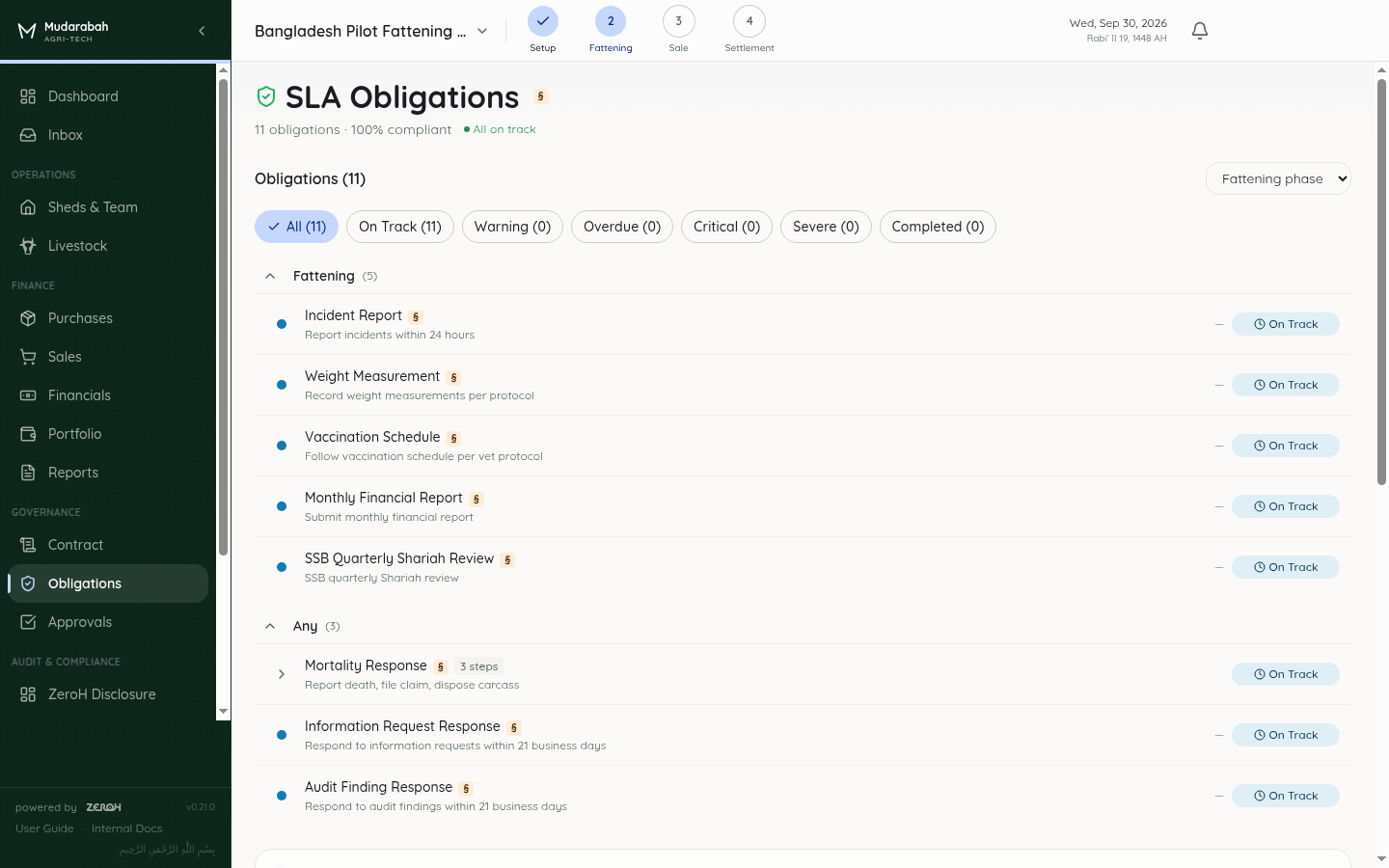
Takaful covers specified livestock risks.
A disease or a flood can take a herd. The contract has every animal enrolled with a local takaful provider within 25 days of the capital arriving. Enrolled cattle have takaful cover for specified events, subject to the provider’s terms, exclusions and claims assessment. Takaful does not guarantee investment capital or returns.
Each cow is identified by its muzzle print, as unique as a fingerprint. If an insured cow dies, the operator reports it within 24 hours with photos, and a vet confirms the cause before the provider assesses the claim.
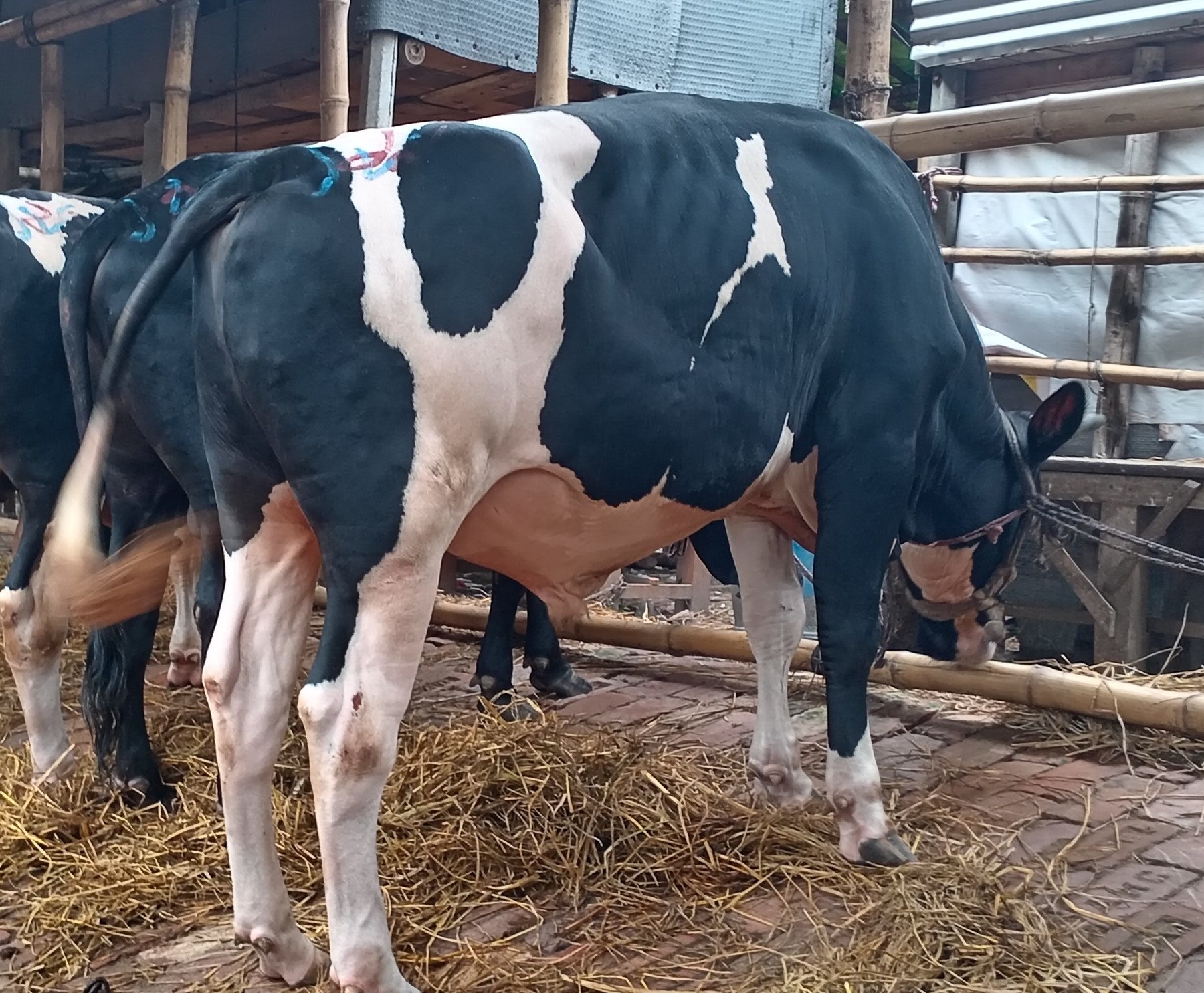
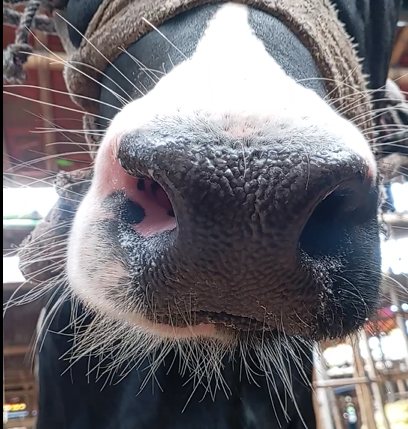
Livestock investment needs evidence investors can check.
A fattening cycle’s outcome depends on livestock sale proceeds and operating costs. It can generate a profit or a loss. The investor is usually in another country, and the evidence has usually been a spreadsheet and a phone call. Drag the handle to compare.
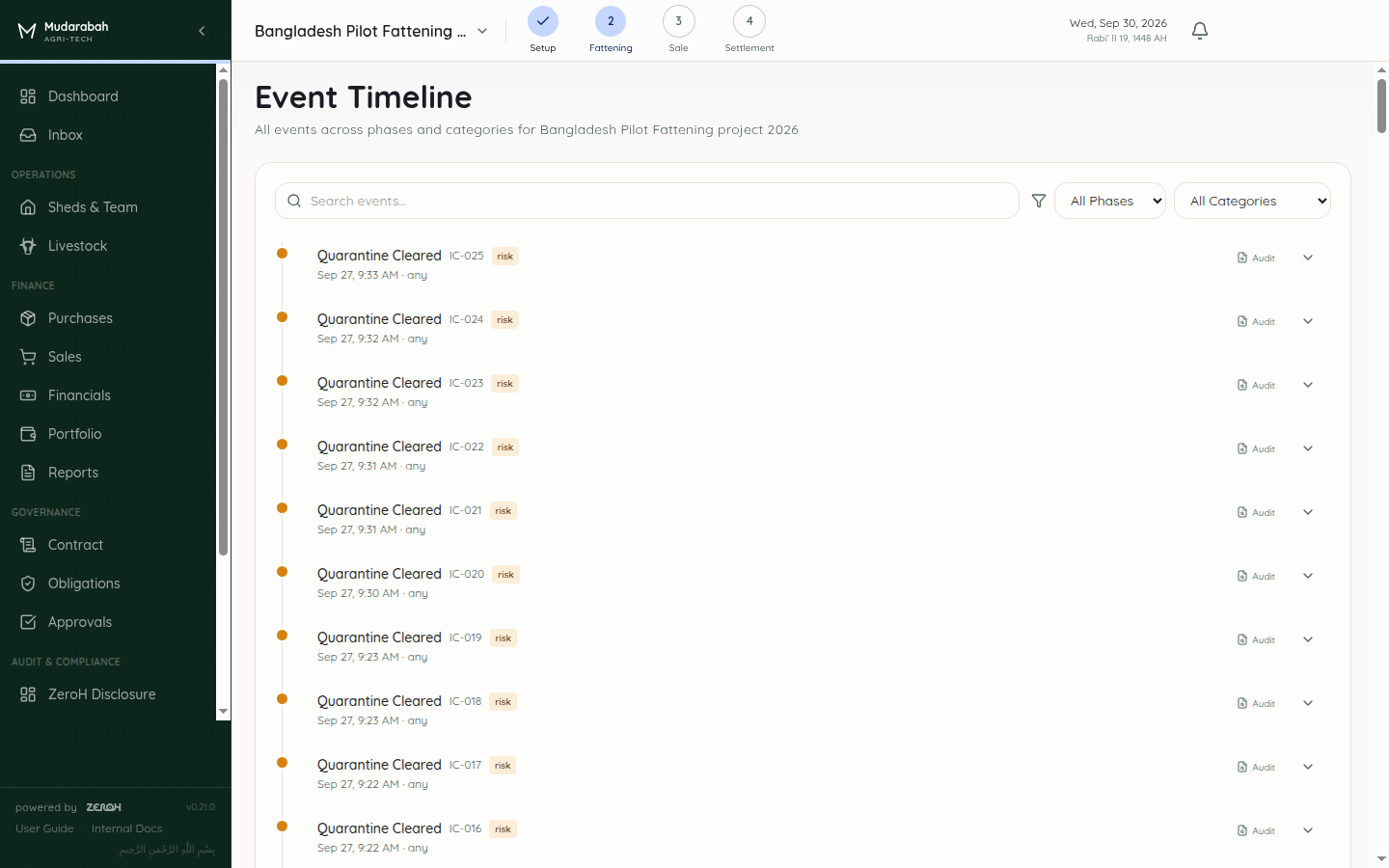
Left: how most livestock deals are usually followed, illustrated. Right: the pilot’s event timeline in the app, every step with its evidence.
Four stages. A gate between each.
A stage opens only when the one before it is complete and signed off. Scroll through one fattening cycle.
Stage 1 · Setup
Capital in, cows registered
The capital arrives and the operator confirms it. The investor approves each purchase. Every cow is registered by its muzzle print within 48 hours and enrolled in takaful.
Gate: capital confirmed, every cow registered and insured.
Stage 2 · Fattening
The herd grows on the record
Farmers feed and care for the herd. Weights, vaccinations and vet checks go into the app, and any incident is reported within 24 hours. The Shariah board reviews each quarter.
Gate: the investor approves the sale plan.
Stage 3 · Sale
Every cow sold in the window
Each cow is sold inside the agreed sale window and recorded with its price and receipt.
Gate: every cow sold or accounted for.
Stage 4 · Settlement
Certified, then shared
Farmers are paid first. The Shariah board certifies the profit, the investor approves the settlement, and both sides confirm each transfer.
Gate: both sides confirm, and the cycle closes.
Ask the contract. Ali knows it clause by clause.
Every role can open Ask Ali inside the app. Ali knows every clause of the agreement, the profit structure, each obligation and its deadline, and which cow is due its vaccination this week. It answers with the clause it relied on, and a person always makes the decision.
It knows nothing sensitive about the farmers or the investors. ZeroH Disclosure decides, field by field and role by role, what Ali may read.
Meet Ask AliAsk Ali · Mudarabah app
Question: Which cows are due a vaccination this week, and what does the contract ask of the vet?
Four cows in the fattening shed are due their FMD booster by Thursday.
The herd-health obligation asks the vet to record each dose in the app the day it is given. The Shariah board sees those records in its quarterly review.
- Herd healthobligation
- Quarterly reviewSSB
- AAOIFI SS 13Mudarabah
- 9 fields read
- 5 withheld
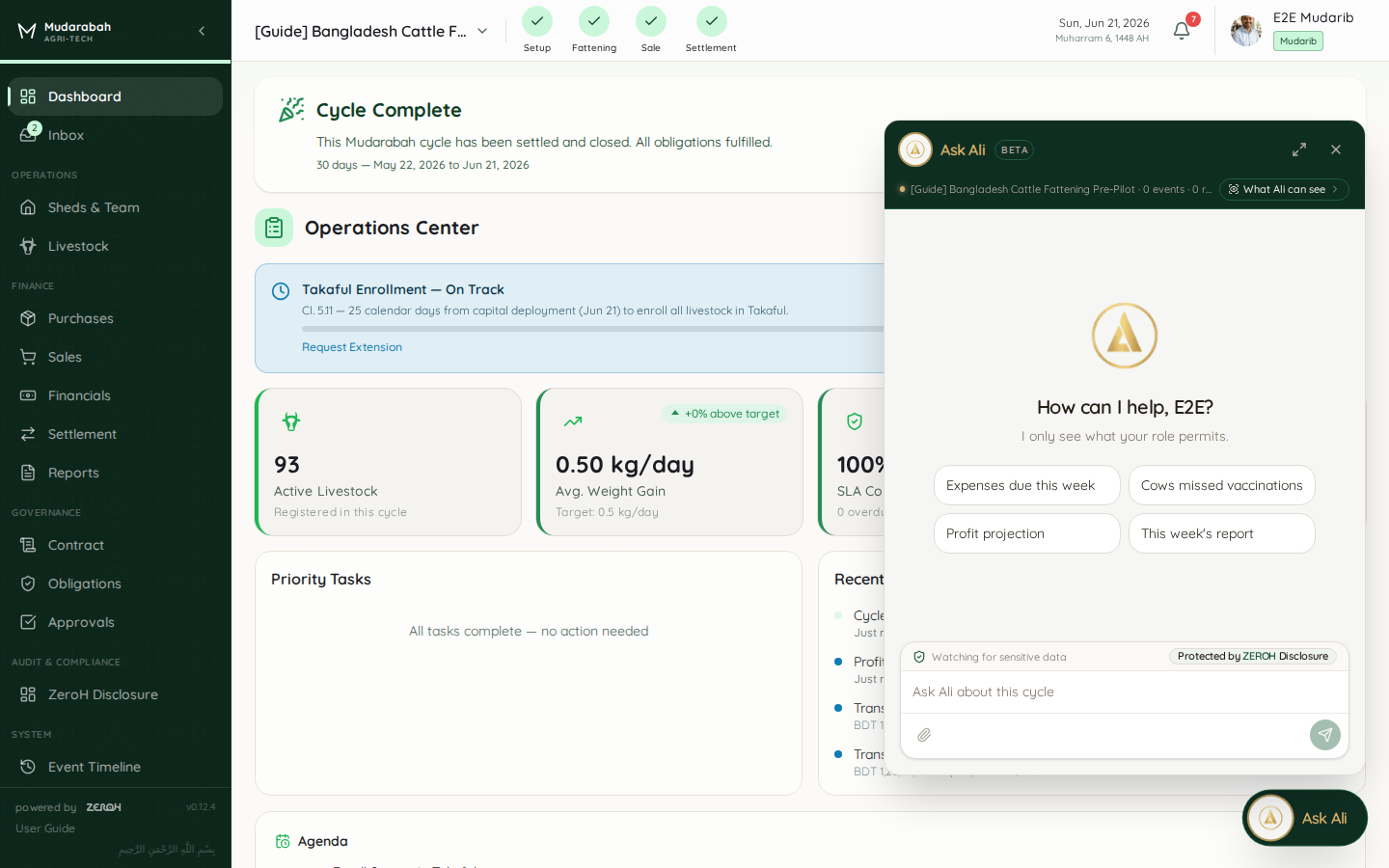
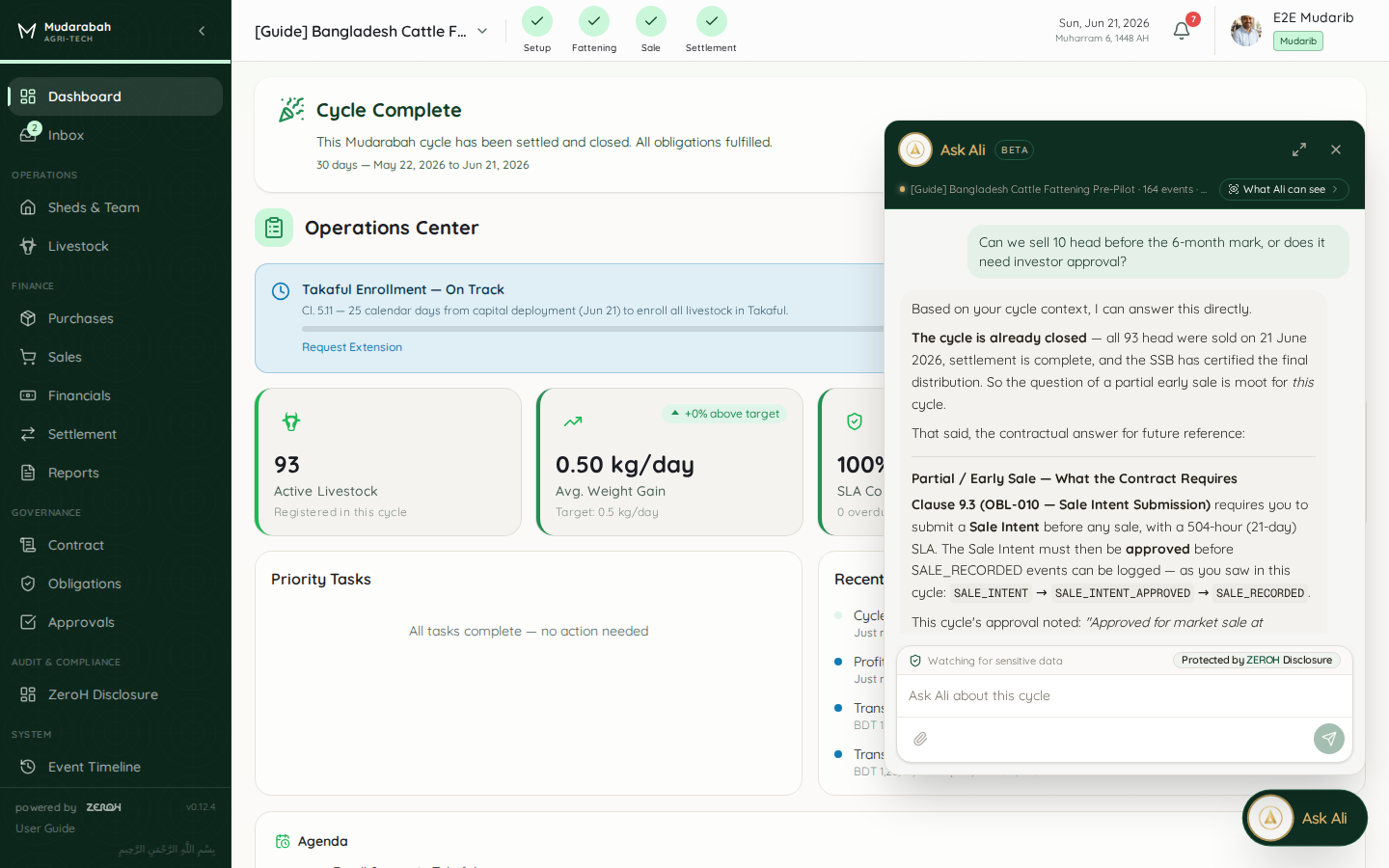
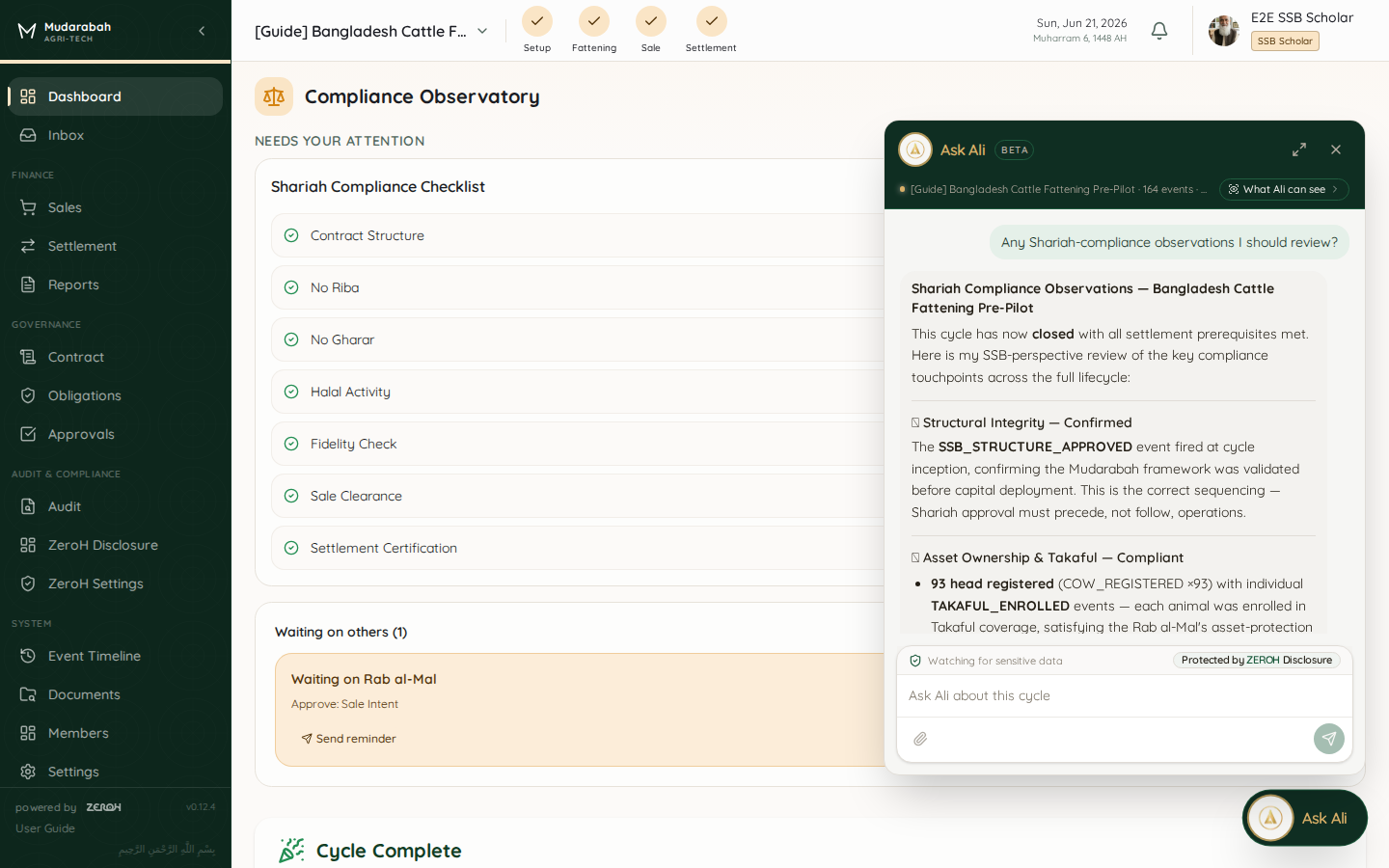
Screenshots from the app’s guided demo cycle, with test accounts.
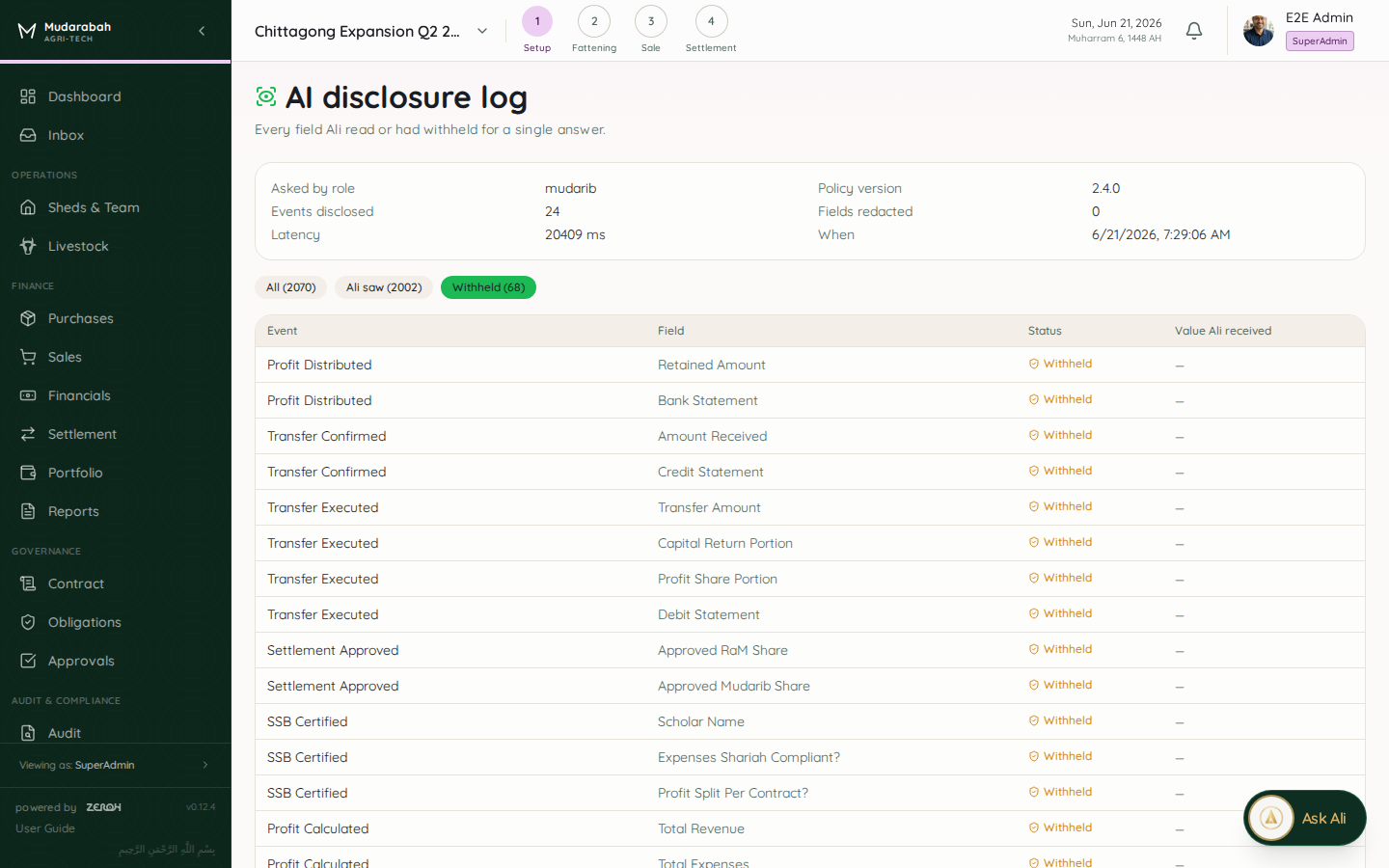
Rules decide what the AI reads. A log proves it.
What Ali may see is not left to the AI. Every event in the contract has a disclosure rule for every role, the AI included. The rules are fixed before anyone asks a question, and an event with no rule stays hidden from everyone.
Each answer is logged: the fields Ali read, the fields it was denied, and the rule version that decided. The data protection officer and the Shariah board can open that log at any time.
- Contract events
- 154
- each with a rule for every role
- Fully visible to the AI
- 54
- herd, obligations, clauses
- With fields withheld
- 100
- names, phones, money
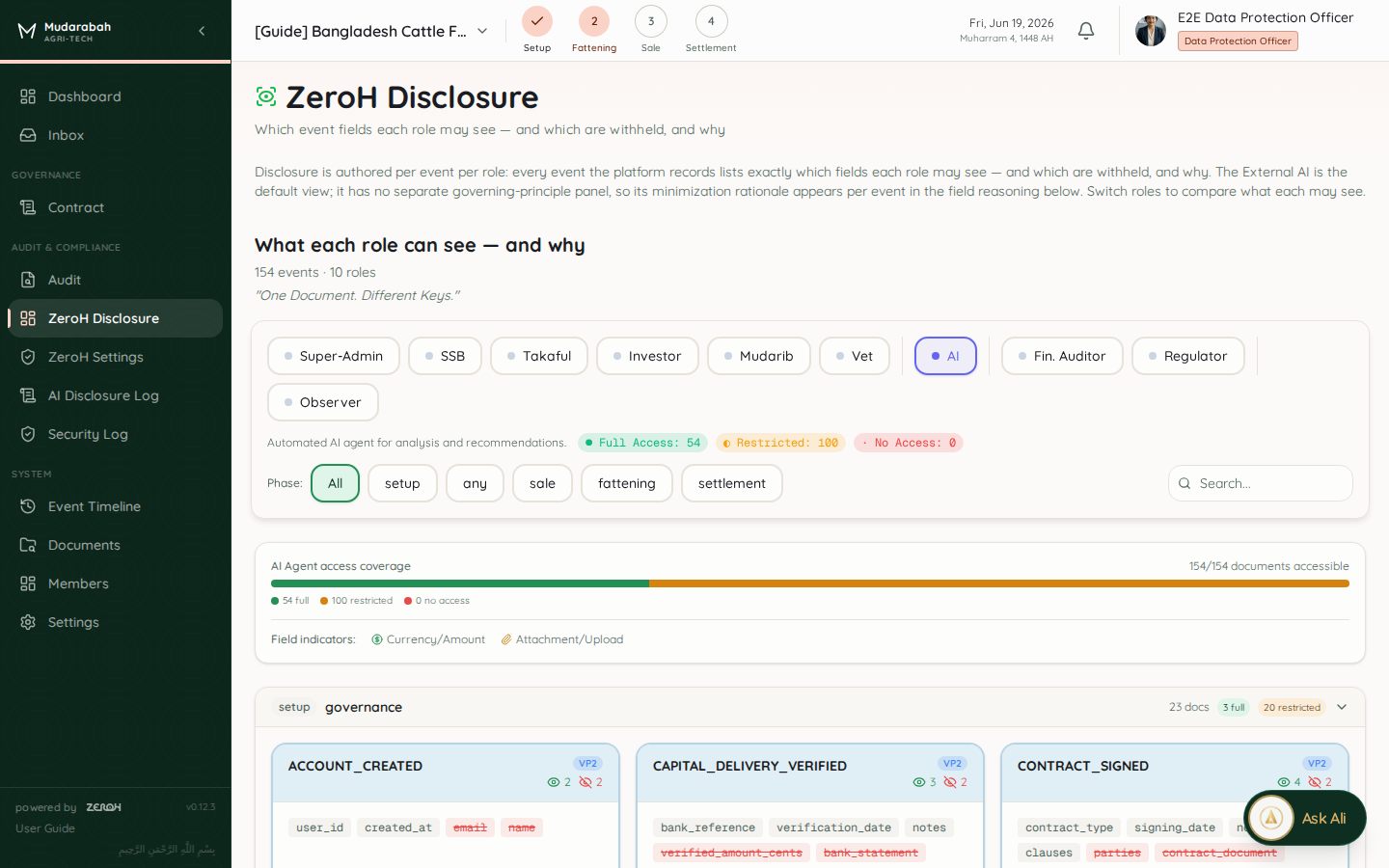
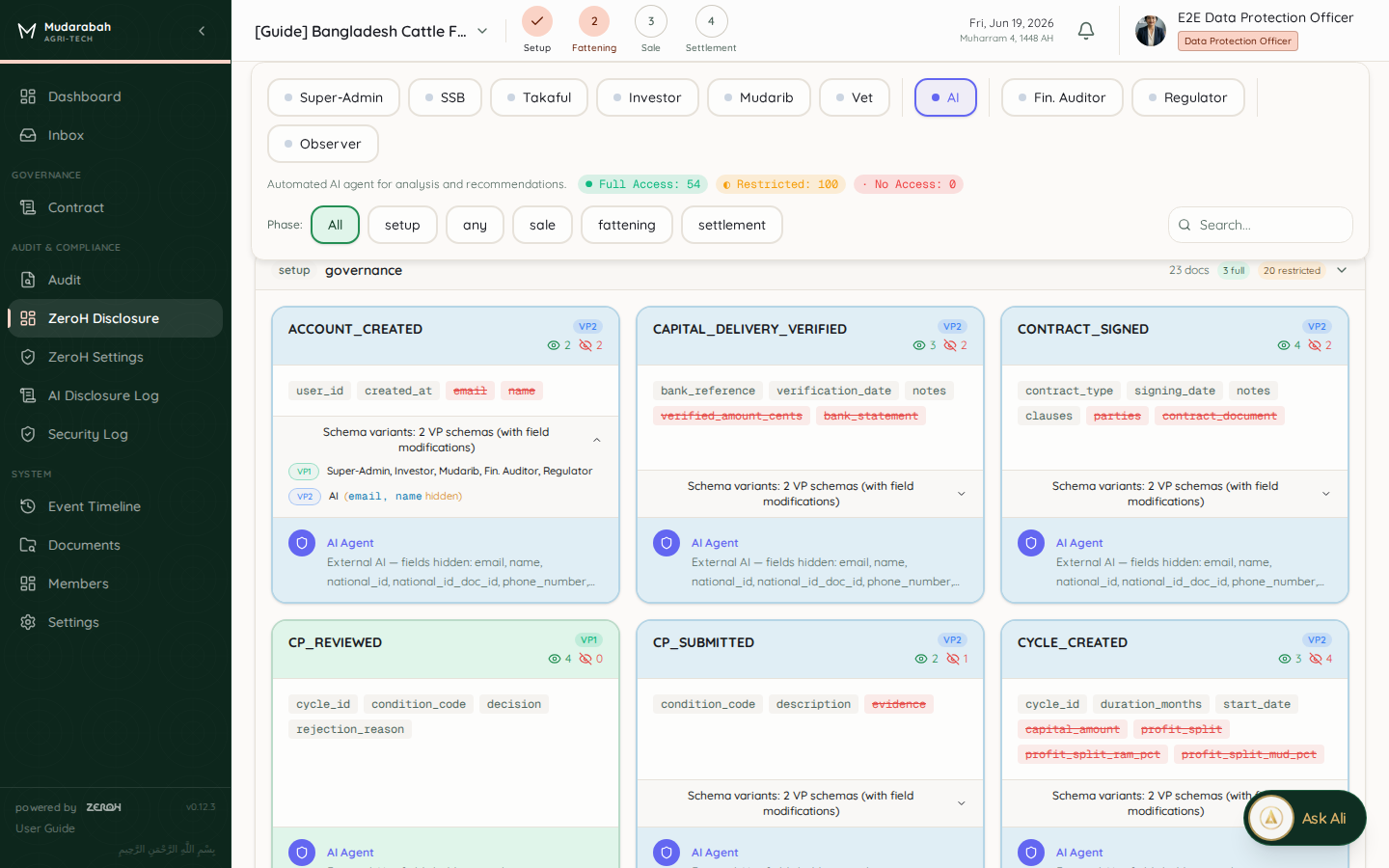
Everyone sees their part, and only their part.
Each role in the contract has its own view and its own rules: the Rab al-Mal, the Mudarib, the Shariah Supervisory Board and the data protection officer, with the vet, the takaful provider and the auditor beside them. A farmer’s phone number stays with the operator; the Shariah board sees the rulings, not the bank details.
The investor
Follows the capital, the herd, the costs and the expected profit, and approves the big decisions.
The farm operator
Buys the cattle, runs the sheds, records every expense and confirms every payment.
The Shariah Supervisory Board
Approves the structure, reviews each quarter and certifies the final profit.
The data protection officer
Checks who saw which field and why, including every answer Ask Ali gave.
The veterinarian
Records vaccinations and health checks, confirms payments and verifies any death.
The takaful provider
Enrols each animal and handles claims, with the evidence already attached.
The board signs off before the money moves, and again before it is shared.
The investor carries a loss of capital unless the operator was negligent or broke the contract, and profit is shared only once the capital is whole. The Shariah board needs evidence to tell those cases apart, and the app has it ready at four points.
01
Before signing
The board approves the structure and sets its conditions. No contract, and no capital, until it does.
02
Every quarter
The board reviews the herd, the spending and every incident, with the evidence in front of it.
03
When something goes wrong
A death or a claim comes with photos and a vet’s report, so the board can tell bad luck from negligence.
04
Before payout
The board certifies the profit calculation. Then the investor approves, and both sides confirm each transfer.
Running in Bangladesh.
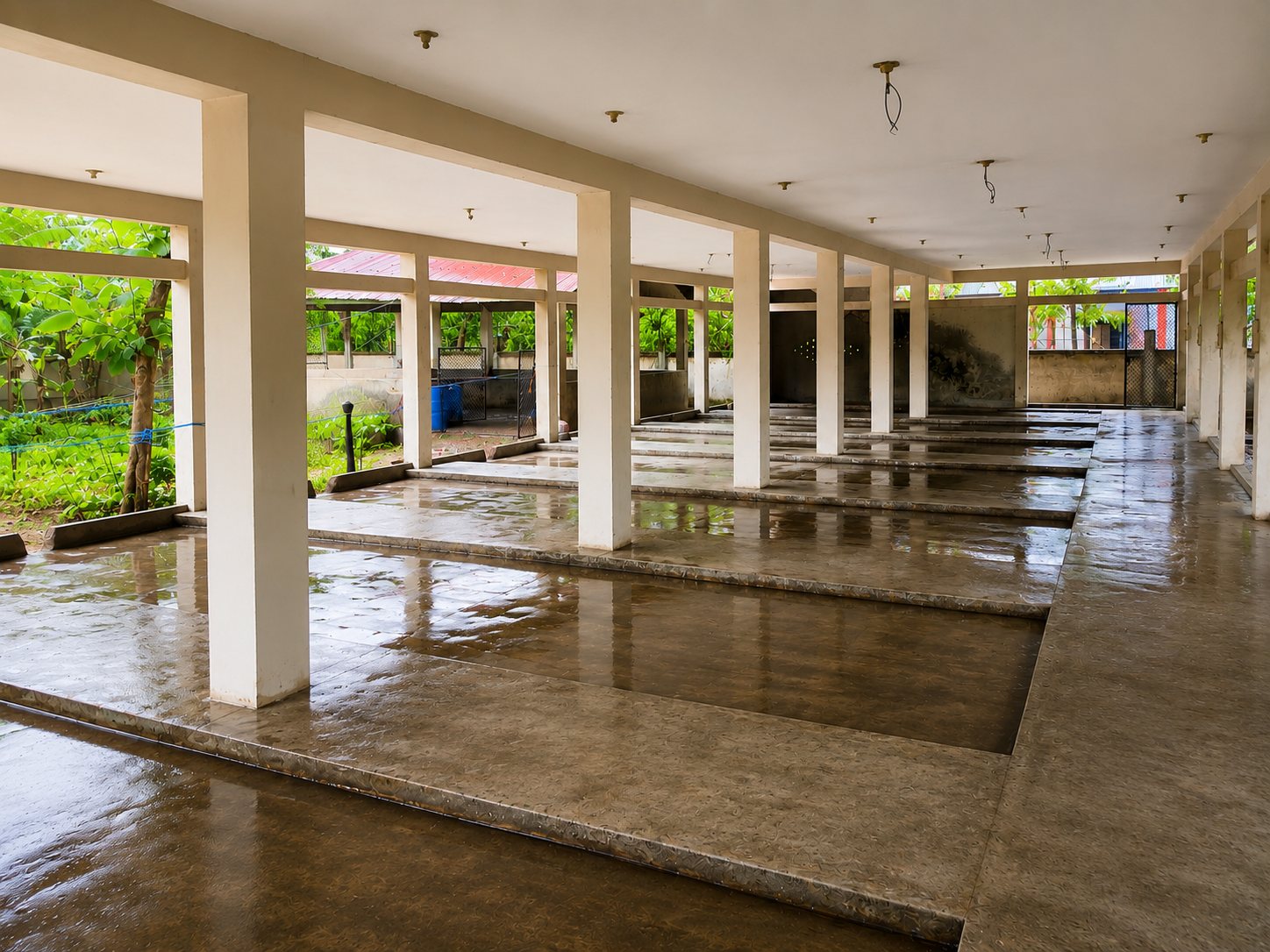
Blade Labs invested $100,000 as Rab al-Mal (the capital provider) in a cattle-fattening Mudarabah run by InsureCow as Mudarib (the operator) in Bangladesh, on a 70/30 investor/operator profit split. The contract, with 41 tracked obligations, was signed on 16 March 2026, and the herd of 22 cows is in its fattening phase.
Read the InsureCow storyWatch one cycle, screen by screen.
Follow the investor’s dashboard: the capital arriving, the contract’s clauses, every obligation and receipt, the investor’s approval of the sale, and the payout that stays locked until the Shariah board certifies it. Every figure in the film is masked.
Bring your farms. Bring your capital.
We are the platform provider, and our own pilot has run on it since March 2026. The contract, the roles, the Shariah board workflows, takaful, Ask Ali and ZeroH Disclosure come ready; you bring the operation or the investment.
Capital is at risk. Returns are not guaranteed, and investors may lose some or all of their investment. Takaful covers specified risks under its terms; it does not guarantee capital or profit. This page provides product information, not investment advice. Obtain independent financial and Shariah advice before committing funds.
Run your fattening cycle on the app.
Register your sheds, farmers and cattle, record every purchase and expense with its receipt, and give your investors a live view that earns their trust and their next cycle.
Fund livestock you can watch.
Place capital as Rab al-Mal in Shariah-compliant cycles with the contract enforced, every payment confirmed by both sides, takaful enrolment for every animal, and your Shariah board in the loop.
The Mudarabah app: common questions
What is Mudarabah?
A Shariah partnership in which the Rab al-Mal provides the capital and the Mudarib provides the work. Profit is shared by an agreed ratio, 70/30 in our pilot, and a loss of capital falls on the investor unless the operator was negligent. AAOIFI Shariah Standard 13 governs it.
Is investing in cattle fattening halal?
It can be a halal investment when it is structured as a Mudarabah or Musharakah approved by a Shariah board: no interest, returns from selling real animals, risk genuinely shared, and cover through takaful rather than conventional insurance. The Mudarabah app was built to make that structure verifiable.
What does takaful cover?
Every animal is enrolled with a local takaful provider within 25 days of the capital arriving and identified by its muzzle print. Enrolled cattle have takaful cover for specified events, subject to the provider’s terms, exclusions and claims assessment. Takaful does not guarantee investment capital or returns. If an insured cow dies, the operator reports it within 24 hours with photos, and a vet confirms the cause before the provider assesses the claim.
What are dual-confirmed receipts?
Every payment is recorded by the payer with its receipt and confirmed by the payee from their own login. If the amounts differ, the app opens a dispute. Records go into append-only, tamper-evident storage that nobody can alter afterwards, including us.
What can Ask Ali see about farmers and investors?
Nothing personal. ZeroH Disclosure fixes per-role rules before any question is asked. Ask Ali reads the contract clauses, obligations, herd health and cycle status, but never names, phone numbers, IDs, bank details, individual cow prices or capital amounts, and every answer logs the fields it read and withheld.
Who can use it?
Farm operators who want to run fattening cycles with investor-grade evidence, and institutional investors placing capital as Rab al-Mal. A password-free demo with sample data for every role is at mudarabah.zeroh.io.
See the whole cycle in ten minutes, then bring us yours.
The demo runs on sample data for every role: investor, operator, Shariah board, vet, takaful provider and auditor. No password needed.