Ask a Shariah question. Get the clause back.
Ali answers in plain language from AAOIFI Shariah Standards, IFSB guidance and published fatwas, and quotes the standard and paragraph it relied on. When the sources do not cover your question, it says so.
Ask Ali · ali.zeroh.io
Question: Must the bank own the asset before it sells it to the client in a murabaha?
Yes. The bank must own the asset and take possession of it, physically or constructively, before it sells it to the client.
Until then the asset is at the bank’s risk, and that risk is what makes the profit permissible. The client may still refuse to buy.
- AAOIFI SS 8§3/1/1
- AAOIFI SS 8§3/2/1
- AAOIFI SS 8§4/1
- 3 references checked
Three real questions, and what Ali said.
An operator with a live contract, a product team checking a brochure, and someone asking for what Ali does not have.
Ask Ali · Mudarabah app
Question: Fuel prices spiked and cow prices are falling. Can we buy a small herd now and sell it in a few weeks?
Yes, if you buy them to fatten. A short cycle is fine: the four-month figure was a commercial estimate, not a Shariah rule, and what matters is the husbandry, not the calendar. Stay within the capital and get the investor’s purchase approval (48 hours) first.
Register every cow on ZeroH. Feed it, have the vet check it and manage its weight gain for as long as you keep it, and insure it under takaful.
Keep the full record: purchase weight and condition, feeding logs, vet records, receipts, sale weight and the net gain, with the monthly financial report. That record shows the intent at purchase was fattening, measured as weight gain.
Where it crosses the line: buying and reselling within days, with no feeding or vet care and no weight gain, only because the price moved. That is trading, outside this Mudarabah, and the Mudarib would carry the loss.
- AAOIFI SS 13Mudarabah
- Contract clause 5.2Mudarib discretion
- Purchase approval48 h
- 14 fields read
- 6 withheld
Illustrative brochure review; not an investment offer
Question: Our Mudarabah brochure says “guaranteed monthly return of 4.5%”. Can we keep that line?
No. In a Mudarabah the profit depends on how the investment actually performs, and the capital provider bears the loss of capital. A fixed, guaranteed return turns it into a loan with interest.
Try: “Profit, if any, is shared at the ratio agreed in the contract and depends on actual investment performance. Neither capital nor returns are guaranteed.”
- AAOIFI SS 13Mudarabah
- Critical finding
- Rewrite suggested
Ask Ali · ali.zeroh.io
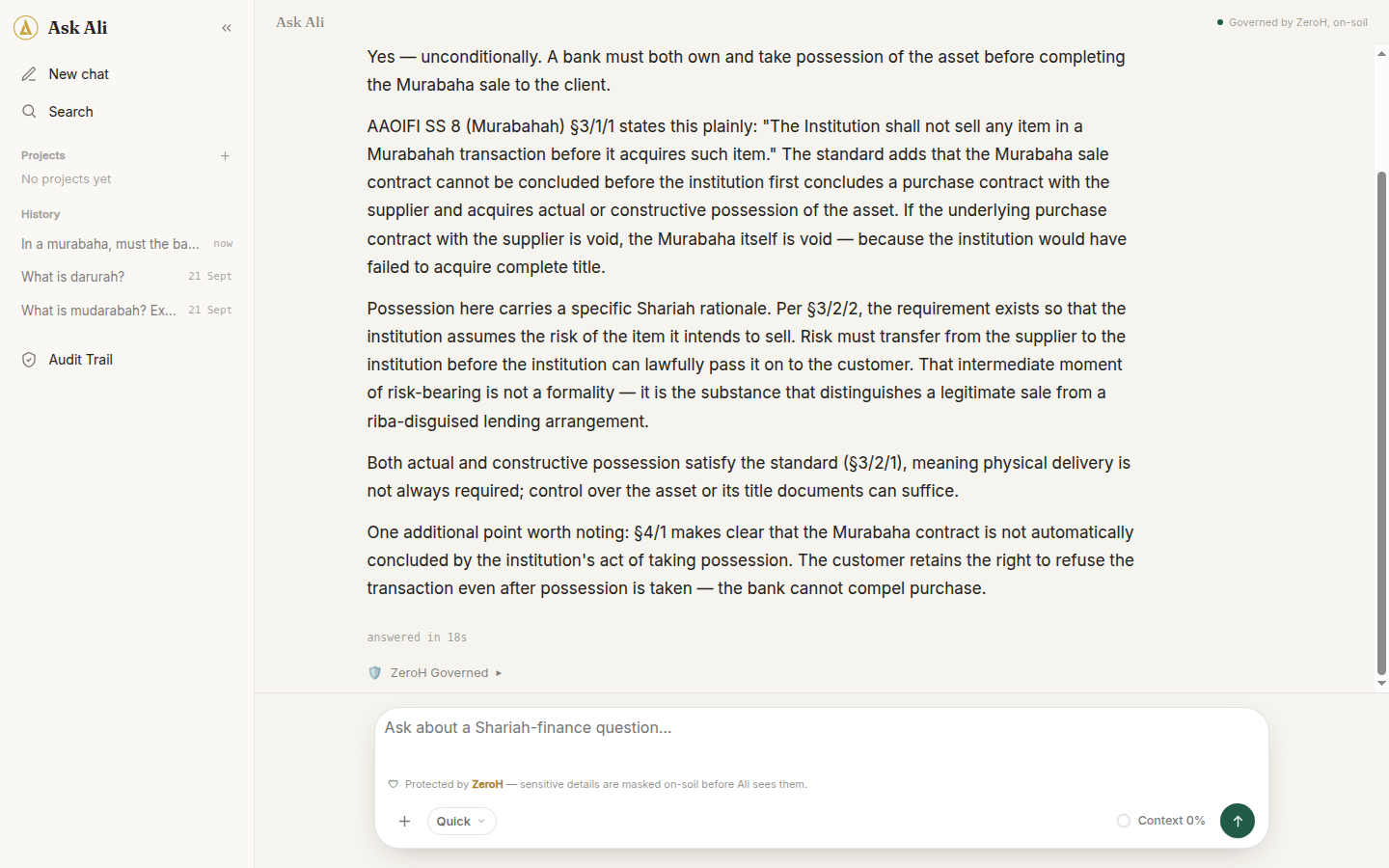
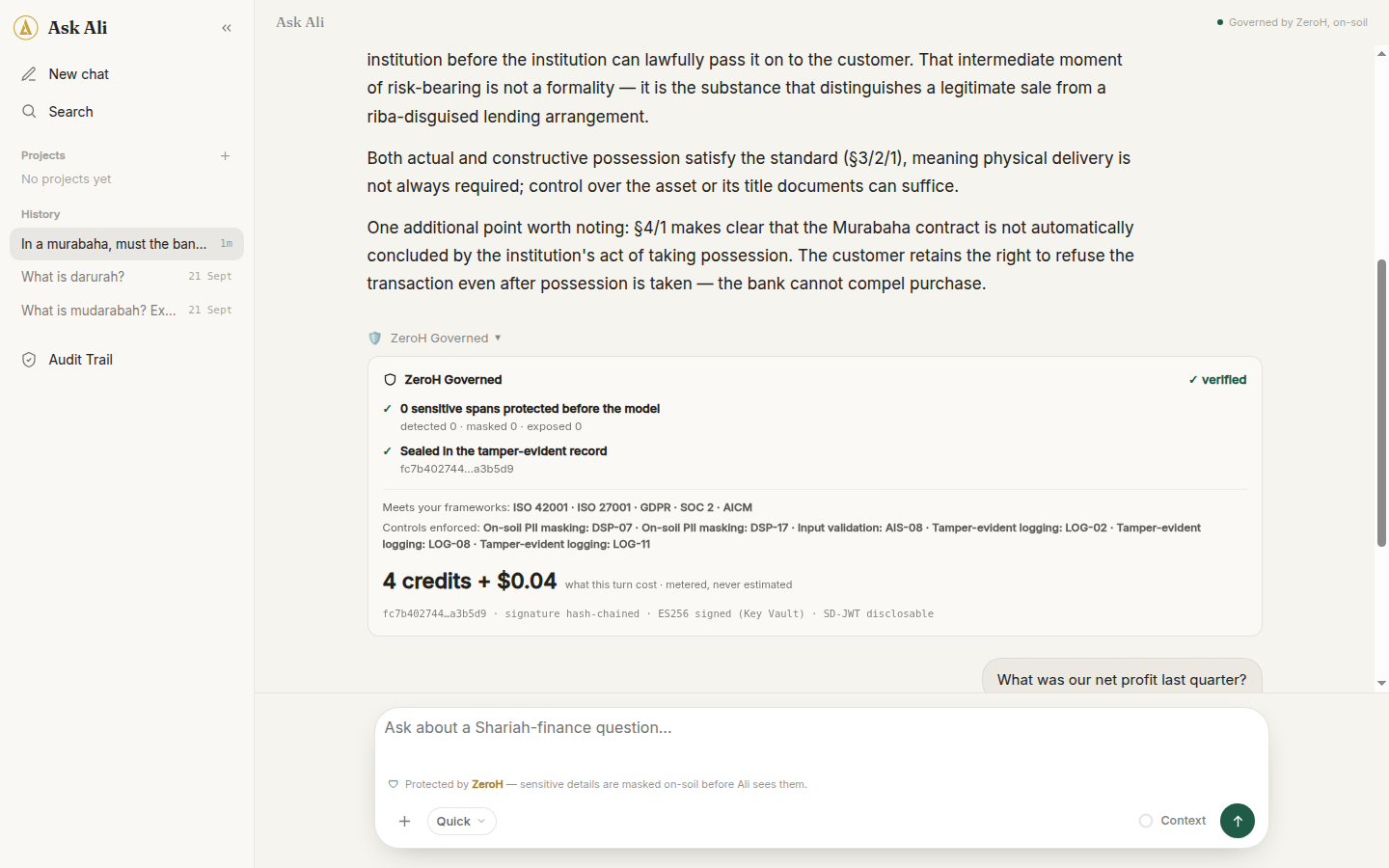
Question: What was our net profit last quarter?
I cannot answer this from the provided sources.
My sources hold the AAOIFI and IFSB standards and published fatwas, not your company’s accounts. Your finance team or your auditor can answer this.
- No source found
- Nothing invented
Ask Ali provides source-based assistance, not a fatwa or investment advice. Your Shariah board remains responsible for decisions.
Check every answer yourself.
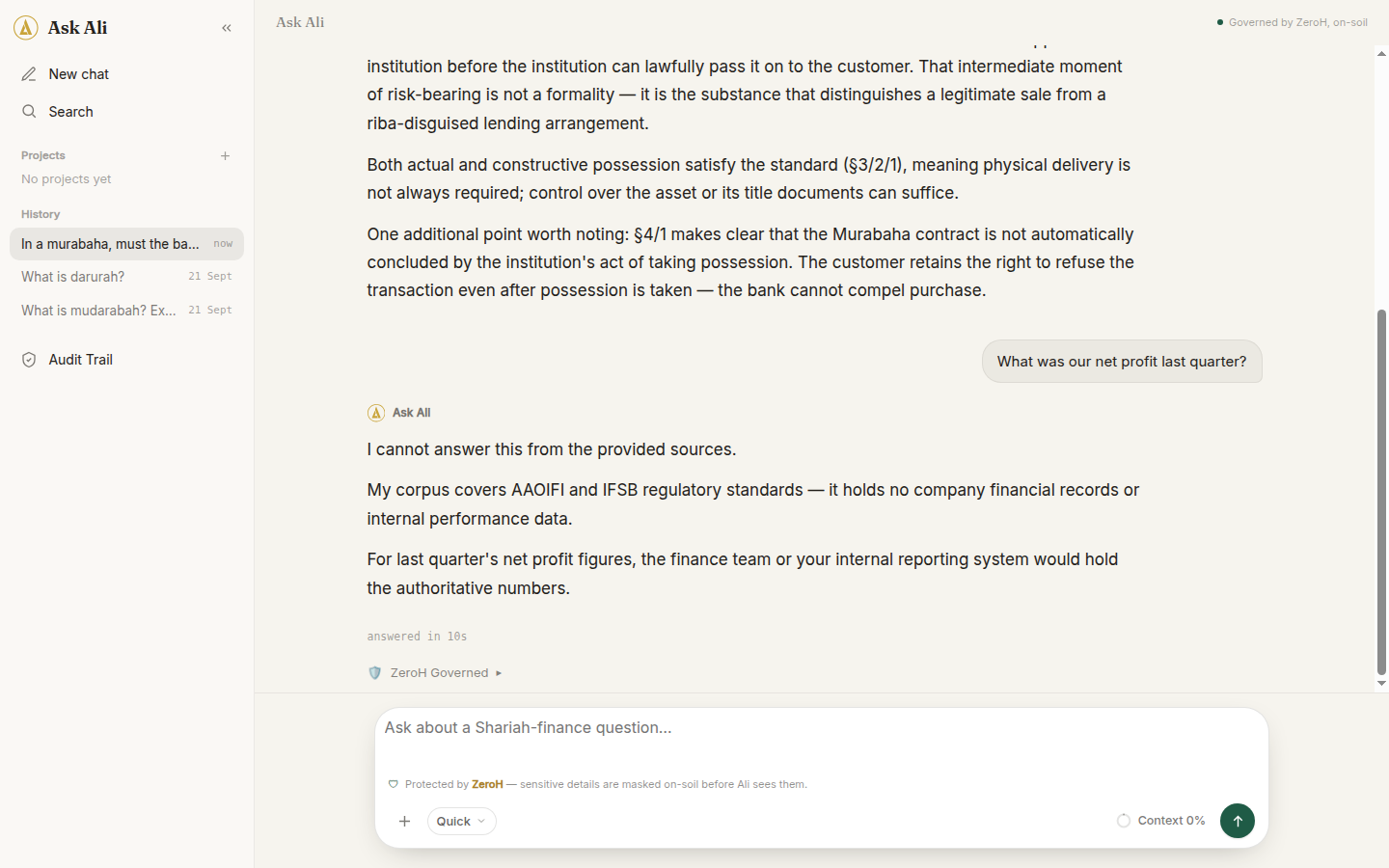
Each source-based answer identifies the material it relies on: AAOIFI Shariah Standard 8, §3/1/1, not “the standards say”. Ali checks each reference before the answer reaches you, and drops any it cannot find.
Pick Quick for a direct answer. Pick Thorough and Ali reads more clauses and writes a fuller, document-grade opinion.
Ask your own question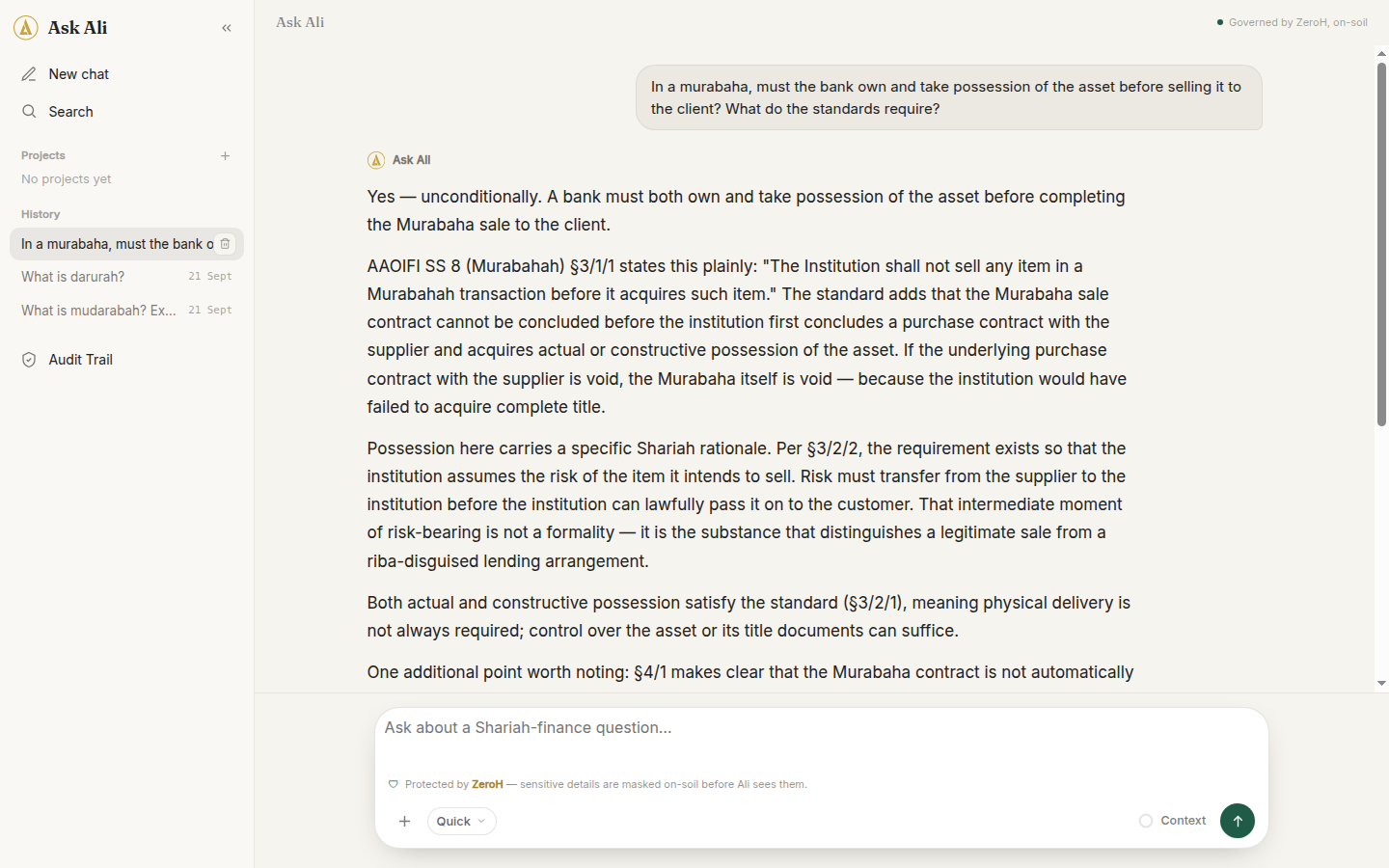
AAOIFI Shariah Standards, IFSB guidance and fatwa sources.
Ask Ali’s reference corpus contains AAOIFI Shariah Standards, IFSB standards and guidance notes, and curated fatwa and jurisprudence sources. Ali answers from that corpus and nothing else. Counted in its index on 1 October 2026:
- AAOIFI Shariah Standards
- 54
- Shariah Standards 1 to 54
- IFSB documents
- 37
- 25 standards, 7 guidance notes, 5 technical notes
- fatwa and jurisprudence sources
- 8
- including the European Council for Fatwa and Research
When the sources run out, Ali says so.
Ali does not answer from memory. It reads first, cites what it read, checks the citations, and stops where the sources stop.
It flags when a question needs your Shariah board, and it never issues a fatwa. Ali supports your Shariah committee. It does not replace it.
01 · Read
Finds the clauses
Searches the standards and fatwas for the paragraphs that bear on your question.
02 · Answer
Answers from them only
Writes the answer in plain language, from what it found and nothing else.
03 · Check
Checks every citation
Looks up each reference again before you see it, and drops any it cannot find.
04 · Stop
Stops where they stop
If nothing covers the question: “I cannot answer this from the provided sources.”
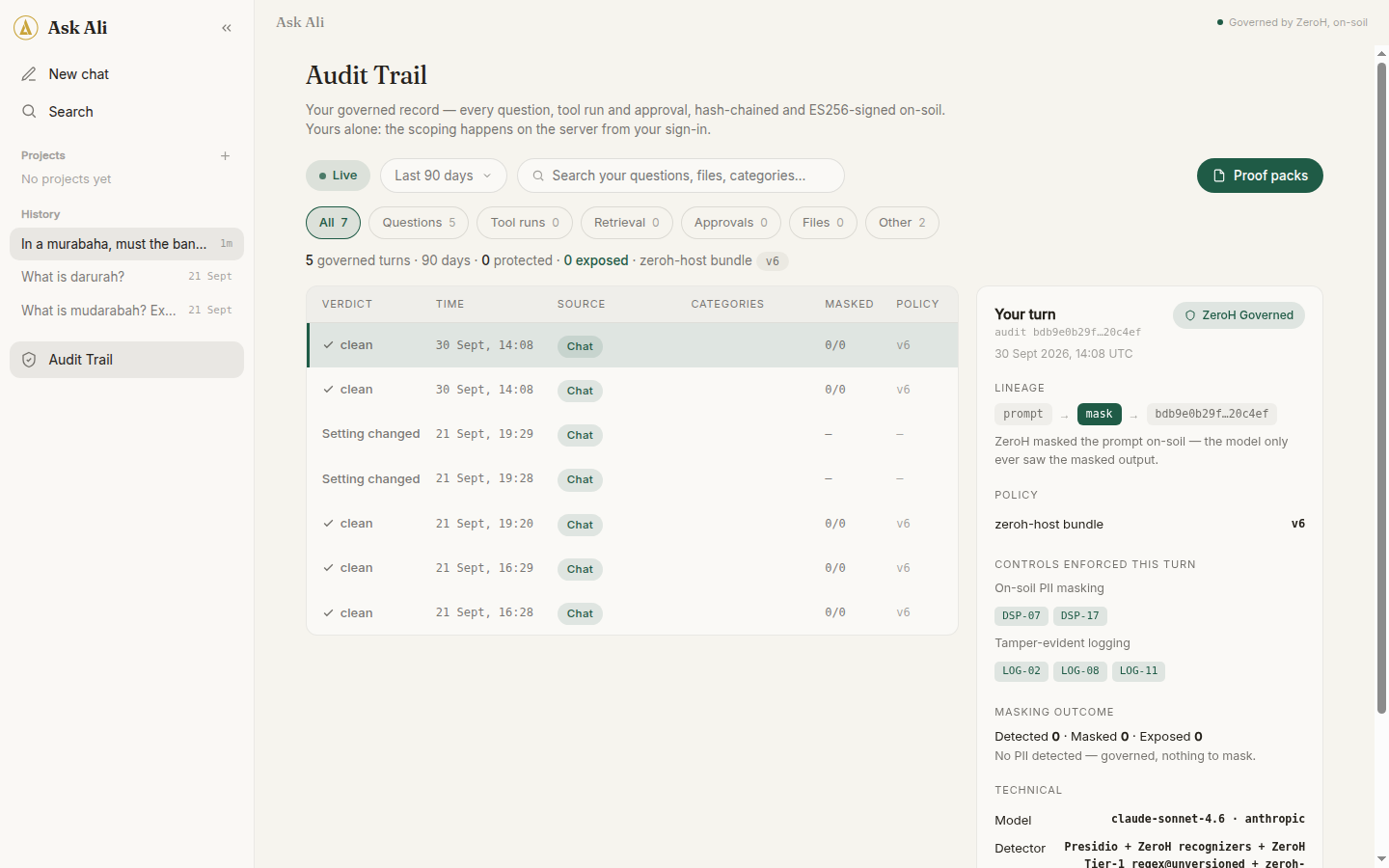
Your clients’ details stay with you.
Names, account numbers and contract IDs are masked on your side before the question reaches the model. Each answer carries a governance card: what was protected, the controls applied and what the turn cost. Every turn is sealed into your own audit trail.
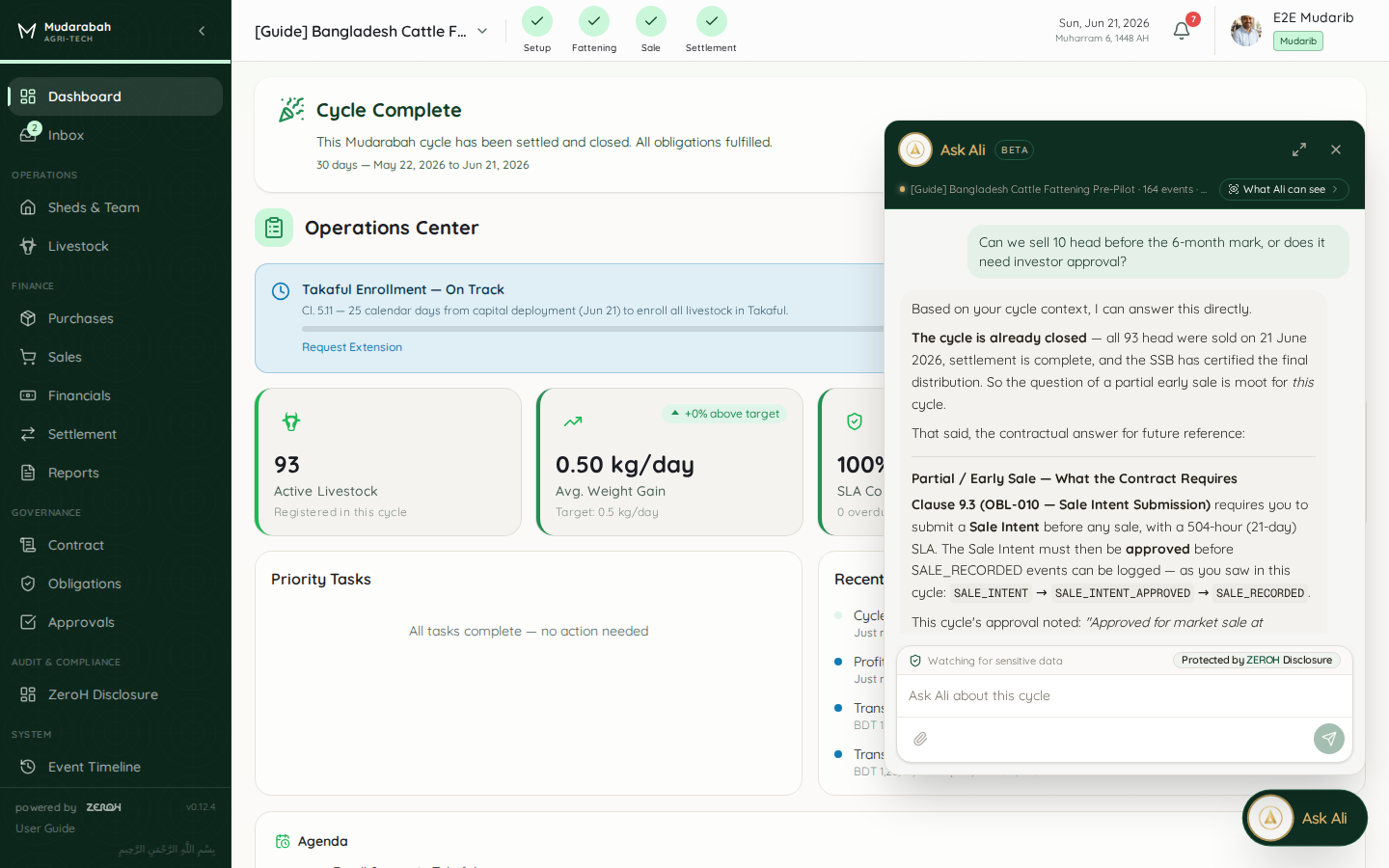
Ali knows the contract. Not the people in it.
In the ZeroH Mudarabah app, every role asks Ali about the live contract: which clause covers an early sale, which cow is due its vaccination, which obligation comes next, how the profit splits.
ZeroH Disclosure decides what Ali may see. It reads the clauses, the deadlines and the herd; the farmers’ and investors’ names, numbers and money stay withheld, and every answer is logged.
Launch a Shariah product with Ali at every step.
Launching an Islamic finance product runs through eleven phases, from the first idea to the Shariah board’s fatwa to go-live. The Shariah Product Launcher maps each phase to workflows Ali runs with your team, and stops at every approval gate until the Shariah committee or board decides.
Mapped for Mudarabah investment accounts, Murabaha auto finance and livestock Mudarabah, with Ijarah next. Twenty of its library workflows already run through Ask Ali in Microsoft Teams; the guided launcher is in alpha.
Eleven phases. Every workflow. Every document.
Pick a phase to see the workflows Ali runs in it, what it asks you for, where it stops for a decision, and what it hands back.
Lead: product development, retail banking and finance.
Customer demand analysis
Pulls regulator and industry data and reads the customer research you already have.
The demand evidence for the product: focus-group themes, branch-survey results and customer-data patterns, checked against market data. Contains: summary, internal findings, market signals, confidence, target segments, method and limits.
Concept and market assessment
Researches the market and sizes it for the segment you choose.
Whether the product is viable: the market opportunity, the product concept and a recommendation. Contains: executive summary, market opportunity, concept, recommendation.
Competitor benchmarking
Compares rival products in the markets you pick.
How similar products from competing Islamic banks compare. Contains: competitor overview, competitive advantages, market positioning.
Product fact sheet
Condenses the research into one page the committee can read.
One page on the product’s features, terms and benefits. Contains: overview, key features, eligibility, risk disclosure.
Recommendation to committee
Bundles the research into a memo for the product committee.
The formal recommendation asking the product committee to approve the concept. Contains: recommendation, rationale, resources needed, requested action.
Shariah committee approval
Reads the committee’s minutes and records its decision. Nothing moves until it decides.
Shariah committee decidesThe Shariah committee’s first decision to let structuring begin. Contains: decision, Shariah basis, conditions of approval.
Risk and profitability
Runs your pricing assumptions through the scenarios you choose.
A first view of the product’s risks, returns and financial viability. Contains: risk summary, profitability projection, recommendation.
Lead: the Shariah advisory division, then Shariah compliance.
Shariah concept paper
Drafts the paper for the Mudarabah model you choose, restricted or unrestricted, with the profit ratio and loss treatment.
The Islamic contract framework for the product. Contains: Shariah structure, contract mechanics, Shariah parameters, the Shariah advisor’s comments.
Contractual role allocation
Maps the Rab al-Mal’s and the Mudarib’s duties to AAOIFI Shariah Standard 13.
The two parties and their rights and duties under AAOIFI Shariah Standard 13. Contains: parties, Mudarib duties, Rab al-Mal rights and loss-bearing, events that require notice.
Shariah pre-clearance
Answers the Shariah division’s notes and checks every point against the AAOIFI standards.
The Shariah department’s confirmation that the structure is ready for the board. Contains: clearance status, structure review, items addressed, next steps.
Lead: product development, with finance and operations.
Pricing model
Builds the pricing from your scenarios and cost of funds.
Profit-sharing ratio scenarios, cost-of-funds curves and pool-sizing assumptions. Contains: ratio scenarios, cost-of-funds curves, pool sizing.
Policies and procedures
Drafts them from the templates you already use.
The operating runbook for the product. Contains: account opening, profit distribution, early withdrawal, escalation paths.
Profit engine specification
Specifies weightages, tiers and the profit-sharing ratio for each segment.
How profit accrues and is shared, ready for the system build. Contains: daily accrual, tier weightages, ratio per segment, reconciliation.
Product governance
Designs the RACI, the process flow and the reporting lines your regulator expects.
Who owns each obligation inside the institution. Contains: obligation owners, RACI matrix, process handoffs, reporting lines, terms of reference.
Business requirements
Assembles everything above into one requirements document.
Everything the build needs, in one document. Contains: product, functional, system and compliance requirements.
Lead: the Shariah Supervisory Board.
Board submission and fatwa
Bundles the concept note, the concept paper, the process flows and the draft contracts, takes in the scholars’ comments, and waits until the board approves or asks for changes.
Shariah board decidesThe board’s formal ruling that approves the product for launch. Contains: decision, Shariah basis, conditions, signatories.
Lead: legal, with compliance.
Mudarabah agreement
Drafts the agreement from the fatwa, under the governing law you choose.
The contract itself: capital, profit-sharing ratio, investment scope, loss and governing law. Contains: recitals, definitions, capital and ratio, scope, loss, disputes.
Terms and conditions
Drafts them from your earlier products and AAOIFI’s disclosure rules.
The customer-facing terms, anchored to the fatwa and AAOIFI Shariah Standard 13. Contains: the relationship, profit ratio, capital and loss, eligible assets, early redemption, consents.
Product disclosure sheet
Follows the template your regulator publishes.
What a customer must know before signing. Contains: product snapshot, how profit is calculated, key risks, fees.
Risk disclosure
Writes the risk language your regulator requires.
The risks in plain words. Contains: capital is not protected, indicative rates are not guaranteed, deposit-protection scope, Shariah-specific risks.
Privacy notice
Adapts your bank-wide notice to this product.
How personal data is collected, used and shared for this product. Contains: what is collected, why, who receives it, the customer’s rights.
This is how the ZeroH Mudarabah app was built: 41 obligations from one signed contract.
Contract roles
Finds every party the executed contract names.
Every party the executed contract names, with its role. In the Mudarabah app: the Rab al-Mal, the Mudarib, the Shariah board, the vet, the takaful provider and the auditor.
Contract clauses
Maps each clause to the parties it binds.
Each clause of the signed contract, mapped to the parties it binds and the events it governs.
Enforceable obligations
Turns clauses into obligations with an owner, a deadline and the evidence each one needs.
Each clause turned into an obligation with an owner, a deadline and the evidence it needs. The Mudarabah pilot has 41.
Events and fields
Maps the events the contract produces and the fields each event carries.
The events the contract produces, in order, and the fields each one carries, so every step leaves a record.
Selective disclosure
Decides, per role and per event, what each party and the AI may see.
Per role and per event, which fields each party and the AI may see. In the Mudarabah app: 154 events, 10 roles.
System configuration
Generates the configuration for your core banking system.
Machine-readable configuration built from the requirements and the fatwa: product code, ledger mappings, profit-engine schedule.
Shariah testing
Checks the test evidence against the rules the board approved.
Proof that the built system follows the approved rules. Contains: compliance status, areas verified, Shariah audit findings, certification.
Lead: marketing, with Shariah and compliance.
Round-table review
Three reviewers, legal, Shariah and compliance, go through each brochure, web page and script. Your team accepts, edits or rejects every finding, with a reason for each rejection.
Findings from the legal, Shariah and compliance reviewers on each brochure, page and script, with the team’s accept, edit or reject decision on every one.
Staff training and FAQs
Drafts the call-centre script and staff training on Mudarabah, the profit-sharing ratio and the loss rules.
The staff FAQ and training on Mudarabah principles, the profit-sharing ratio, loss rules and eligible assets, with answers to common Shariah objections.
Lead: operations, finance and Shariah audit.
Go-live certification
Checks the readiness matrix for the launch window you choose.
The final confirmation that every launch criterion is met. Contains: decision, readiness checklist, launch plan, approvals.
Monthly profit allocation
Allocates the pool’s actual returns each cycle, for approval before anyone is paid.
The cycle’s actual returns, allocated across the pool for approval before anyone is paid. Contains: cycle summary, allocation, reconciliation.
Shariah audit and review
Prepares the evidence for the ongoing Shariah audit and the annual independent review.
The records the ongoing Shariah audit and the annual independent review check: compliance status, key metrics, pool composition, recommendations.
On the web, in Teams, and in the contract.
Ask Ali where your specialists already work, with a governance card on every answer.
A Shariah advisor for every role in a live contract, governed by ZeroH Disclosure.
Ask Ali runs on the ZeroH platform, covered by a Shariah pronouncement from the Shariah Supervisory Board of Amanie Advisors, dated 23 April 2025.
Ask Ali, the AI Shariah advisor: common questions
What is Ask Ali?
Ask Ali is the AI Shariah advisor from ZeroH, made by Blade Labs. It answers Islamic-finance questions from its reference corpus, which on 1 October 2026 held 54 AAOIFI Shariah Standards, 37 IFSB standards, guidance notes and technical notes, and 8 fatwa and jurisprudence sources, and identifies the standard and paragraph it relied on, such as AAOIFI Shariah Standard 8, §3/1/1. It provides source-based assistance, not a fatwa or investment advice.
What is the Shariah Product Launcher?
The Shariah Product Launcher, in alpha, maps the eleven phases of launching an Islamic finance product to workflows Ask Ali runs with your team, from the Shariah concept paper and board submission to a clause-by-clause review of terms and conditions, disclosures and marketing copy. It stops at each approval gate until your Shariah committee or board decides.
How does Ask Ali avoid inventing fatwas?
It answers only from the sources it retrieves, cites them in the answer, and checks each reference before showing it. When the sources do not cover a question it says “I cannot answer this from the provided sources.” It flags when a question needs your Shariah board, and it never issues fatwas.
Does Ask Ali see my personal data?
No. Names, account numbers and other sensitive details are masked on your side before the question reaches the model, and every answer leaves a receipt in your audit trail showing what was protected.
Where can I use Ask Ali?
On the web at ali.zeroh.io, in Microsoft Teams, and inside the ZeroH Mudarabah app, where it knows the contract clause by clause without seeing who the farmers and investors are.
Is Ask Ali Shariah-certified?
Ask Ali runs on the ZeroH platform, which is covered by a Shariah pronouncement from the Shariah Supervisory Board of Amanie Advisors, dated 23 April 2025. Ask Ali is not a Shariah board and does not replace one; a person always decides.
Give your team a Shariah advisor your board can check.
Start free on the web. For your institution, talk to us about running Ali inside your own Shariah contracts.